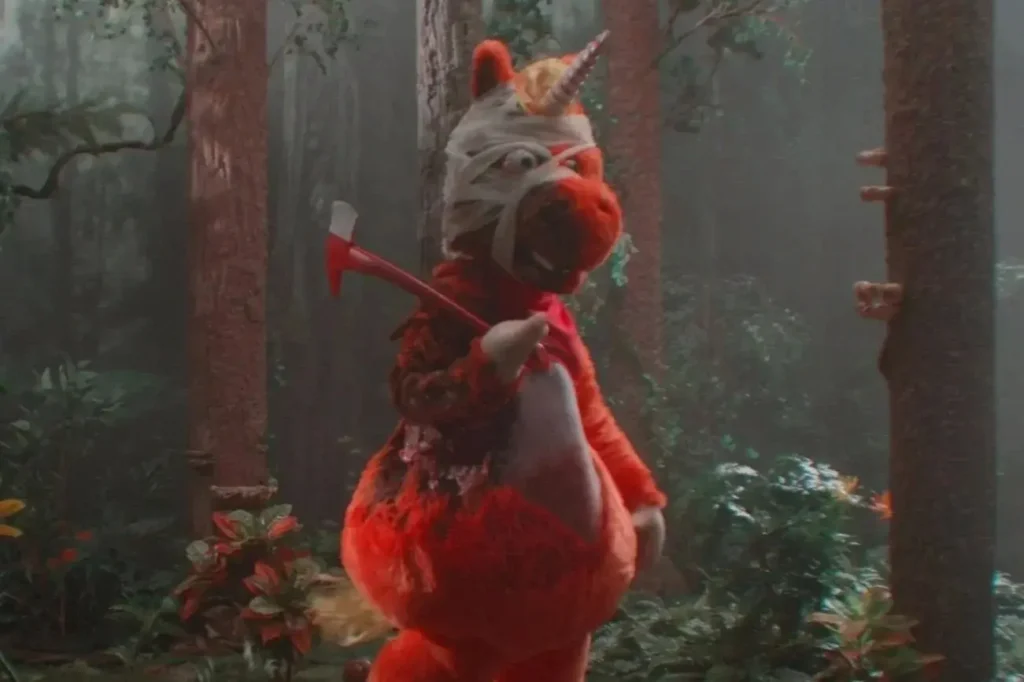
There’s something inherently unsettling about taking a piece of childhood nostalgia and turning it into horror. Casper Kelly, the filmmaker behind the wonderfully deranged Too Many Cooks, takes exactly that approach with Buddy, a bizarre horror comedy that looks at 1990s children’s television through a very different lens.
The premise is simple enough: a group of children find themselves trapped inside the world of a seemingly cheerful kids’ TV program, where Buddy, an enormous orange unicorn, is supposed to teach them valuable life lessons. The problem is that Buddy is also a deeply disturbed psychopath.
What follows is a strange mixture of children’s television parody, horror, dark comedy and 1990s nostalgia. And for a while, Buddy is genuinely terrific.
The movie doesn’t maintain that momentum throughout its entire runtime, but there is enough creativity here to make it difficult to dismiss.
What Is Buddy About?
Buddy follows a group of children living inside a strange 1990s-style children’s television program hosted by Buddy, a giant orange unicorn. At first, everything appears harmless. Buddy teaches the kids about chores, baseball, dancing and other wholesome activities you’d expect from an old-school children’s show.
That cheerful façade doesn’t last.
When one of the children refuses to participate in one of Buddy’s lessons, the character’s disturbing side begins to emerge. Before long, Freddy, played by Delaney Quinn, and several of the other children realize that something is seriously wrong with the world they’ve been trapped in.
Their hope of escaping leads them toward Diamond City, a mysterious place that promises freedom from Buddy’s increasingly terrifying control.
It’s an intentionally strange setup, and the movie gets a surprising amount of mileage out of it.
Buddy’s First Act Is Easily Its Best
The first half-hour of Buddy is where Casper Kelly’s concept really comes alive.
Rather than immediately turning the movie into a conventional horror story, Kelly presents the audience with a series of fake children’s television episodes. Each one becomes progressively stranger and darker, allowing the cheerful presentation to slowly give way to something much more sinister.
That’s where the movie’s Too Many Cooks DNA is most obvious.
Kelly understands how funny—and disturbing—it can be when familiar television conventions are pushed just a little too far. The bright sets, costumes, puppets and educational lessons initially feel nostalgic before the cracks begin appearing underneath them.
The result is genuinely funny in places and surprisingly unsettling in others.
It also helps that the movie doesn’t immediately explain everything. The audience gets to experience Buddy’s world alongside the children, which makes the gradual shift from harmless children’s entertainment to nightmare fuel much more effective.
Keegan-Michael Key Is Perfect as Buddy
Keegan-Michael Key might be the biggest reason the movie’s central joke works as well as it does.
As Buddy, Key captures the exaggerated enthusiasm of a children’s television host while adding just enough menace to make the character deeply uncomfortable. His performance sounds like a warped cousin of the friendly children’s mascots that dominated television in the 1990s.
That contrast is essential.
Buddy is supposed to be cheerful, educational and comforting. Instead, there’s something increasingly wrong behind the smile, and Key understands exactly how far to push that idea without completely turning the character into a conventional horror villain.
The performance also gives the movie much of its comedic energy.
Whenever Buddy returns to the children’s television world, Key’s voice work helps recreate the strange mixture of innocence and menace that makes the premise so effective.
1990s Nostalgia Does a Lot of the Heavy Lifting
There’s no getting around it: Buddy is heavily dependent on nostalgia.
Anyone who grew up watching children’s television during the 1990s will immediately recognize the visual language Kelly is playing with. The costumes, educational segments, colorful sets and relentlessly positive tone are all deliberately familiar.
The most obvious comparison is Barney & Friends, although Buddy is not simply a Barney story with the names changed.
Instead, Kelly takes the broader formula of 1990s children’s programming and turns it into something disturbing. The result works best when the movie allows the audience to recognize the familiar setup before twisting it into something much darker.
That also means Buddy may not connect as strongly with younger horror audiences who don’t have the same attachment to that era of television.
For Gen X viewers and older millennials, however, the nostalgia could be a major part of the fun.
How Too Many Cooks Connects to Buddy
Casper Kelly’s connection to Too Many Cooks is impossible to ignore.
That Adult Swim short became famous for taking something completely ordinary—the opening credits of a sitcom—and gradually transforming it into something increasingly bizarre and disturbing. Buddy applies a similar instinct to children’s television.
The difference is that stretching the concept across a feature-length movie creates a much bigger challenge.
Kelly clearly knows the material he’s parodying. The fake TV segments are filled with details that make the fictional program feel like something that could genuinely have existed decades ago.
When the movie stays inside that world, it is at its most inventive.
Unfortunately, Buddy eventually moves away from the concept that makes it so distinctive.
The Real-World Story Takes Some of the Energy Away
The biggest problem with Buddy arrives when the movie leaves its bizarre television universe and spends more time in the real world.
Cristin Milioti and Topher Grace play a suburban couple whose lives may be connected to the strange world surrounding Buddy. Milioti, as expected, gives the material plenty of energy and becomes an important secondary presence in the story.
But the shift in setting comes at a cost.
The movie suddenly feels less distinctive. The colorful insanity of Buddy’s world is replaced by a more conventional suburban storyline, and the momentum built during the first act starts to disappear.
It isn’t that the real-world material is completely ineffective. The problem is that it isn’t nearly as interesting as what came before it.
After spending the opening portion of the film inside Kelly’s wonderfully twisted version of children’s television, returning to a more familiar setting feels like a detour.
Buddy Struggles With Its Feature-Length Runtime
This is ultimately where Buddy runs into its biggest problem.
The movie has an excellent short-film idea at its core, but expanding that concept to feature length exposes some weaknesses.
At roughly 90 minutes, Buddy isn’t particularly long. Even so, there are stretches where the movie feels like it is searching for material to fill out its runtime.
The pacing becomes especially noticeable during the middle section. The first act moves quickly because the central concept is constantly changing and escalating. Once the movie settles into its real-world storyline, that sense of discovery disappears.
The final act does recover some of the earlier energy by returning to Buddy’s world, but the movie never completely reaches the heights of its opening stretch.
It’s a case where less might have been more.
The Horror Works Best When Buddy Is Just Being Buddy
Calling Buddy a straightforward horror movie would be misleading.
This is much closer to a horror comedy and dark satire, with the horror coming from the increasingly disturbing behavior of a character who looks like he belongs in a children’s program.
The movie does use conventional horror techniques, including jump scares and some flashy editing choices. But those moments aren’t nearly as effective as the underlying concept.
The most unsettling parts are often the simplest ones: Buddy behaving like an impossibly cheerful children’s entertainer while the audience knows something is very wrong.
That’s where the movie’s horror comes from.
When it relies too heavily on conventional scares, Buddy becomes less interesting.
Delaney Quinn Gives the Movie a Strong Center
Delaney Quinn’s Freddy serves as the emotional anchor for the children’s storyline.
Freddy is one of the kids who recognizes that Buddy’s world isn’t what it appears to be, and Quinn gives the character enough determination to make the escape story work.
That’s important because the movie could easily have treated its young characters as nothing more than pieces in the larger parody.
Instead, Freddy provides a recognizable protagonist for the audience to follow as the situation becomes increasingly dangerous.
Quinn isn’t asked to carry the entire movie, but she gives the first act the grounding it needs.
The Supporting Cast Adds Plenty of Character
The cast goes well beyond Key and Quinn.
Cristin Milioti and Topher Grace become central once the story moves into the real world, while Patton Oswalt lends his voice to Strappy, a bizarre backpack character that fits perfectly into the movie’s warped children’s-TV aesthetic.
There are also some fun appearances and voice performances, including Clint Howard and Michael Shannon.
These additions don’t necessarily fix the movie’s structural problems, but they contribute to the sense that Kelly is having a lot of fun building this strange fictional universe.
Is Buddy Based on Barney & Friends?
Buddy is clearly inspired by the look and feel of 1990s children’s television, with Barney & Friends being one of the most obvious comparisons.
However, the movie isn’t an official Barney & Friends adaptation.
Instead, Casper Kelly uses familiar children’s-TV conventions as the foundation for a horror satire. Buddy is designed to evoke the kind of oversized, cheerful character audiences might remember from that era while taking the concept in a much darker direction.
That distinction is important because the movie’s appeal comes from recognizing the formula and watching Kelly corrupt it.
Is Buddy Worth Watching?
If the premise sounds like your kind of thing, Buddy is worth checking out.
The movie’s first act alone contains enough creativity to justify a viewing, particularly for anyone who grew up with 1990s children’s television or remembers the bizarre comedy of Too Many Cooks.
It also helps that Keegan-Michael Key clearly understands exactly what kind of performance Buddy requires.
The problems arrive when the movie attempts to expand beyond its strongest idea. The real-world storyline slows the pace, and the feature-length structure makes the film feel longer than its runtime suggests.
Still, there’s enough personality here to make Buddy more interesting than a conventional horror comedy.
Buddy Review Verdict
Buddy is an uneven movie, but it’s never a boring one for very long.
Casper Kelly has created a genuinely strange satire of 1990s children’s programming, and when the movie is locked into Buddy’s world, it can be hilarious, disturbing and surprisingly inventive at the same time.
The problem is that the film doesn’t maintain that creative energy once it moves away from its central concept. The real-world storyline slows everything down, while the 90-minute runtime somehow feels stretched.
Keegan-Michael Key is excellent, Delaney Quinn makes for a likable young protagonist, and the supporting cast adds plenty of memorable touches. But the biggest star here is Kelly’s imagination.
Buddy may not completely work as a feature-length horror comedy, but its best moments are too good to ignore.
For viewers who grew up in the 1990s, it could be exactly the kind of bizarre nostalgia trip they didn’t know they needed.
Verdict: A wildly creative first act and a terrific Keegan-Michael Key performance make Buddy worth watching, even if the movie can’t sustain its best ideas for the full runtime.
Rating: 6.5/10
Buddy FAQs
1. What is Buddy about?
Buddy follows a group of children trapped inside a 1990s-style children’s television program run by a psychopathic humanoid unicorn named Buddy. As his behavior becomes increasingly disturbing, the children attempt to escape his world.
2. Who plays Buddy?
Keegan-Michael Key provides the voice of Buddy, giving the character an exaggerated children’s-TV personality with a much darker edge.
3. Is Buddy a horror movie?
Buddy is best described as a horror comedy and dark satire. It combines children’s-TV parody, 1990s nostalgia, comedy and horror rather than functioning as a traditional straight horror film.
4. Is Buddy based on Barney?
Buddy is not an official Barney & Friends movie. It draws heavily from the style and conventions of 1990s children’s television, with Barney serving as an obvious point of comparison.
5. Who directed Buddy?
Buddy was directed by Casper Kelly, who is best known for creating the surreal Adult Swim short Too Many Cooks.
6. Is Buddy worth watching?
Yes, particularly if you enjoy dark comedy, horror satire, 1990s nostalgia or Casper Kelly’s previous work. The first act is the movie’s strongest material, although the middle section loses some momentum.
Stay updated with the latest trends on Fandomora — your go-to destination for breaking movie news, web series updates, anime releases, gaming trends, celebrity insights, and music updates. Explore reviews, OTT release dates, anime guides, gaming walkthroughs, and curated lists to discover the best in global entertainment.
About The Author