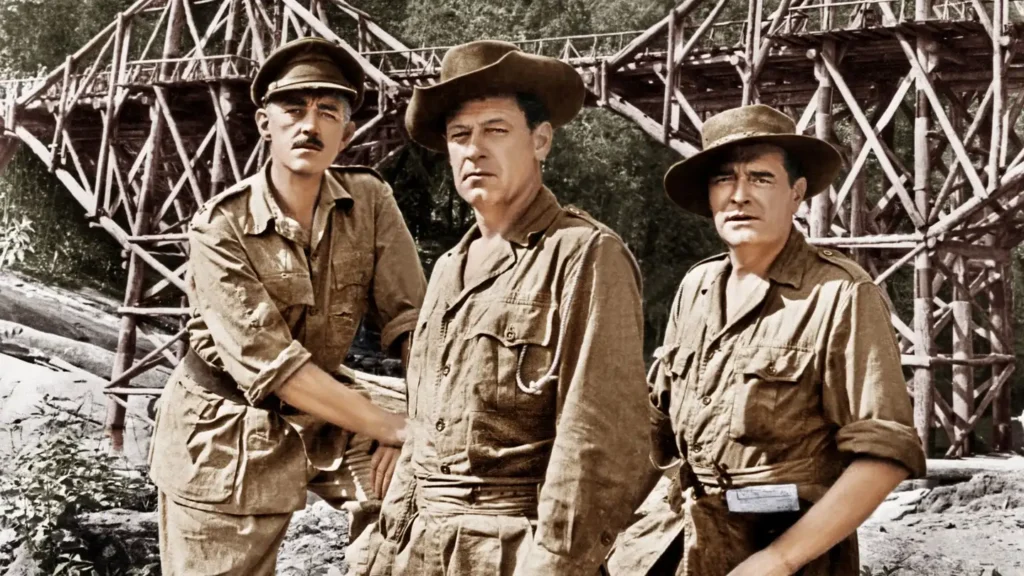
The Bridge on the River Kwai cast features an acclaimed ensemble led by Alec Guinness, William Holden, Jack Hawkins and Sessue Hayakawa. Released in 1957 and directed by David Lean, The Bridge on the River Kwai is one of the defining war films of classic Hollywood, combining a prisoner-of-war drama with a complex story about military duty, pride and obsession.
The movie follows British prisoners held by the Japanese during World War II who are ordered to build a railway bridge in Burma. At the center of the story is Colonel Nicholson, played by Alec Guinness, whose determination to prove the superiority of British engineering gradually complicates his understanding of duty.
The Bridge on the River Kwai Cast at a Glance
| Actor | Character |
|---|---|
| Alec Guinness | Colonel Nicholson |
| William Holden | Commander Shears |
| Jack Hawkins | Major Warden |
| Sessue Hayakawa | Colonel Saito |
| James Donald | Major Clipton |
| Geoffrey Horne | Lieutenant Joyce |
| André Morell | Colonel Green |
| Peter Williams | Captain Reeves |
| John Boxer | Major Hughes |
| Harold Goodwin | Private Grogan |
| Percy Herbert | Private Muldoon |
| Ann Sears | Nurse |
| M.R.B. Hooper | British Soldier |
Alec Guinness as Colonel Nicholson
Alec Guinness plays Colonel Nicholson, the senior British officer commanding the prisoners at the Japanese camp. Nicholson is arguably the most important character in The Bridge on the River Kwai because his sense of military discipline and pride drives much of the film’s conflict.
When Colonel Saito orders the British officers to participate in manual labor, Nicholson refuses on the grounds that officers should not perform such work under the Geneva Convention. His resistance results in harsh punishment, but Nicholson eventually agrees to oversee the construction of the bridge.
What begins as an attempt to maintain British discipline gradually becomes an obsession with building the best possible bridge. Guinness’s restrained performance earned him the Academy Award for Best Actor, and the role remains one of the defining performances of his career.
William Holden as Commander Shears
William Holden plays Commander Shears, an American naval officer who is being held at the Japanese prisoner-of-war camp.
Shears is considerably more skeptical than Nicholson. While Nicholson becomes increasingly invested in completing the bridge, Shears is focused on survival and escaping the camp.
After escaping, Shears becomes involved with Major Warden’s mission to destroy the bridge. His character provides an important contrast to Nicholson because he sees the project as part of the Japanese war effort rather than as an opportunity to demonstrate British excellence.
Holden’s performance also gives the movie a strong American perspective and provides much of its action-driven momentum.
Jack Hawkins as Major Warden
Jack Hawkins portrays Major Warden, a British commando officer who leads the mission to destroy the bridge.
Warden represents a different interpretation of military duty from Nicholson. While Nicholson becomes personally invested in constructing the bridge, Warden understands that destroying it is necessary because it is being used to support the Japanese war effort.
His storyline becomes especially important in the final act, when the sabotage mission converges with Nicholson’s completed bridge.
Sessue Hayakawa as Colonel Saito
Sessue Hayakawa plays Colonel Saito, the Japanese commander of the prisoner camp.
Saito is responsible for ordering the British prisoners to work on the bridge. His confrontation with Colonel Nicholson establishes one of the film’s central conflicts: the struggle between military authority, cultural expectations and personal pride.
Hayakawa’s performance gives Saito considerable presence without reducing him to a simple villain. His relationship with Nicholson becomes increasingly complicated as the construction progresses.
Hayakawa received an Academy Award nomination for Best Supporting Actor for his performance.
James Donald as Major Clipton
James Donald plays Major Clipton, the British medical officer and one of the most important observers of the conflict between Nicholson and Saito.
Clipton often acts as a voice of reason when Nicholson’s decisions become increasingly extreme. His perspective is important because he recognizes that the bridge project is changing from a simple survival strategy into something Nicholson has begun to take personal pride in.
His character also helps the audience question whether Nicholson is still serving his men and country or simply serving his own sense of accomplishment.
Geoffrey Horne as Lieutenant Joyce
Geoffrey Horne portrays Lieutenant Joyce, a young British officer who becomes part of Major Warden’s mission to destroy the bridge.
Joyce’s role becomes increasingly important during the final operation. He is tasked with helping place explosives on the bridge, putting him directly in the path of the construction project Nicholson has spent so much effort completing.
His character represents the younger generation of soldiers who must follow orders even when the emotional consequences are difficult.
André Morell as Colonel Green
André Morell plays Colonel Green, another British military figure within the story.
Although his role is smaller than those of Guinness, Holden or Hawkins, Morell contributes to the film’s broader depiction of British military command and the strategic thinking surrounding the bridge.
His presence helps establish the larger military context behind the individual conflict at the prisoner camp.
Peter Williams as Captain Reeves
Peter Williams appears as Captain Reeves, one of the British officers among the prisoners.
Reeves is involved in the bridge construction and represents the group of officers working under Nicholson’s command. His role helps show how the bridge project develops from an enforced labor assignment into a highly organized engineering operation.
John Boxer as Major Hughes
John Boxer plays Major Hughes, another British officer connected to the prisoner group.
Like several of the supporting characters, Hughes helps establish the hierarchy within the British camp and reinforces the film’s focus on military discipline and leadership.
Harold Goodwin as Private Grogan
Harold Goodwin portrays Private Grogan, one of the British prisoners at the camp.
Grogan is part of the group of enlisted men forced to participate in the construction of the bridge. His character contributes to the film’s depiction of the difficult conditions experienced by the prisoners.
Percy Herbert as Private Muldoon
Percy Herbert plays Private Muldoon, another British prisoner of war.
Muldoon’s character adds to the ensemble of soldiers working under Nicholson’s direction. His presence helps make the construction project feel like a collective undertaking rather than something carried out solely by the principal characters.
Ann Sears as Nurse
Ann Sears appears as a nurse in the film’s supporting cast. Her role is relatively small compared with the major military characters, but she contributes to the movie’s depiction of the wider wartime environment.
The film’s supporting performers help create the sense that the story exists within a much larger military conflict rather than in isolation around the bridge.
The Bridge on the River Kwai Supporting Cast
The Bridge on the River Kwai cast includes numerous supporting actors who portray British prisoners, Japanese soldiers, officers and other figures surrounding the central characters.
While Alec Guinness, William Holden, Jack Hawkins and Sessue Hayakawa dominate the story, the supporting cast is crucial to establishing the atmosphere of the prisoner camp and the enormous effort required to construct the bridge.
Their performances also reinforce the film’s central themes of military hierarchy, survival, loyalty and the psychological effects of war.
Who Plays the Main Characters in The Bridge on the River Kwai?
The principal Bridge on the River Kwai actors are Alec Guinness as Colonel Nicholson, William Holden as Commander Shears, Jack Hawkins as Major Warden and Sessue Hayakawa as Colonel Saito.
James Donald’s Major Clipton is another important character because he provides an outside perspective on Nicholson’s increasingly complicated behavior. Geoffrey Horne’s Lieutenant Joyce becomes particularly important during the final sabotage operation.
Who Is the Main Character in The Bridge on the River Kwai?
Although the film has an ensemble cast, Colonel Nicholson is the central character. Alec Guinness’s performance drives the movie’s emotional and thematic conflict.
Nicholson initially appears to be defending the rights and dignity of his officers. However, his determination to build the bridge gradually becomes so intense that he loses sight of its strategic purpose.
That transformation is what makes the character so compelling. Nicholson is neither a straightforward hero nor a conventional villain; his actions are shaped by discipline, pride and an increasingly distorted sense of duty.
Also Read :
1. Who Was Garth Avery? The Forgotten Woman Who Inspired Jodie Foster’s Iconic ‘Taxi Driver’ Performance
2. The 5 Biggest Marvel Reveals From D23 2026
3. Actors in The Suite Life of Zack & Cody: Complete Cast and Character Guide
Why Is Alec Guinness So Important to the Film?
Alec Guinness’s performance is one of the major reasons The Bridge on the River Kwai remains influential.
Rather than playing Nicholson as a simple military stereotype, Guinness gradually reveals the character’s psychological transformation. The audience can understand why Nicholson initially resists Saito while also recognizing how his obsession with the bridge becomes dangerous.
Guinness won the Academy Award for Best Actor for the performance, cementing the role as one of the highlights of his career.
What Is The Bridge on the River Kwai About?
The Bridge on the River Kwai follows British prisoners of war held by the Japanese during World War II. They are ordered to construct a railway bridge that will support the Japanese military’s Burma Railway.
Colonel Nicholson initially refuses to cooperate with Colonel Saito because of the treatment of British officers. Eventually, however, Nicholson takes charge of the project and becomes determined to build a bridge that demonstrates British engineering skill.
Meanwhile, Commander Shears escapes the camp and later becomes involved in a British mission to destroy the completed bridge.
The result is a war drama built around a conflict between duty, pride, military strategy and personal obsession.
The Bridge on the River Kwai Cast and Characters: Why the Performances Matter
The strength of the film’s cast comes from the way each principal actor represents a different interpretation of duty.
Alec Guinness’s Nicholson represents discipline and professional pride. William Holden’s Shears is primarily concerned with survival and practicality. Jack Hawkins’s Warden represents strategic military duty, while Sessue Hayakawa’s Saito embodies authority and personal pride.
These conflicting motivations prevent the story from becoming a simple battle between heroes and villains. Instead, the characters constantly challenge one another’s understanding of what military duty actually means.
The Bridge on the River Kwai Awards and Legacy
The Bridge on the River Kwai was a major critical and commercial success. At the 30th Academy Awards, it won seven Oscars, including Best Picture, Best Director for David Lean and Best Actor for Alec Guinness.
The film has also remained one of the most celebrated productions of classic British-American cinema. Its performances, direction, editing, cinematography and memorable musical elements have helped it maintain a strong reputation decades after its original release.
The movie’s famous whistling theme, known as the “Colonel Bogey March,” became closely associated with the film and is still recognizable today.
Is The Bridge on the River Kwai Based on a True Story?
The film is not a literal retelling of one specific true story. It was adapted from Pierre Boulle’s 1952 novel Le Pont de la Rivière Kwaï, which itself was inspired by the historical context of the Burma Railway and the experiences of prisoners of war.
The actual construction of bridges and railways by Allied POWs was real and involved severe suffering. However, the film’s specific characters, events and dramatic storyline are fictionalized.
That distinction is important when discussing the movie’s historical accuracy.
Frequently Asked Questions
1. Who is in The Bridge on the River Kwai cast?
The principal cast includes Alec Guinness as Colonel Nicholson, William Holden as Commander Shears, Jack Hawkins as Major Warden and Sessue Hayakawa as Colonel Saito. James Donald, Geoffrey Horne, André Morell and several other actors make up the supporting cast.
2. Who played Colonel Nicholson in The Bridge on the River Kwai?
Alec Guinness played Colonel Nicholson. His performance won the Academy Award for Best Actor.
3, Who played Colonel Saito?
Sessue Hayakawa played Colonel Saito, the Japanese commander of the prisoner-of-war camp. Hayakawa received an Oscar nomination for his supporting performance.
4. Who played Commander Shears?
William Holden played Commander Shears, the American prisoner of war who eventually joins the mission to destroy the bridge.
5. Who played Major Warden?
Jack Hawkins played Major Warden, the British officer responsible for leading the mission to sabotage the bridge.
6. Who directed The Bridge on the River Kwai?
David Lean directed The Bridge on the River Kwai. The film was released in 1957 and became one of the most acclaimed productions of his career.
7. Is The Bridge on the River Kwai historically accurate?
The film draws from the real history of Allied POWs and the Burma Railway, but its principal characters and central storyline are fictionalized. It should therefore be viewed as a historical drama rather than a completely factual account.
Final Thoughts
The Bridge on the River Kwai cast remains one of the film’s greatest strengths. Alec Guinness leads the ensemble with his Oscar-winning performance as Colonel Nicholson, while William Holden, Jack Hawkins and Sessue Hayakawa provide equally important perspectives on the story’s complicated ideas about duty and war.
What makes the cast particularly effective is that the characters aren’t simply divided into good and bad sides. Each major performance explores a different form of military loyalty, from Nicholson’s obsession with discipline and craftsmanship to Warden’s strategic thinking and Shears’s instinct for survival.
More than six decades after its release, The Bridge on the River Kwai remains a landmark war film, and its cast is a major reason the movie continues to attract new audiences.
Stay updated with the latest trends on Fandomora — your go-to destination for breaking movie news, web series updates, anime releases, gaming trends, celebrity insights, and music updates. Explore reviews, OTT release dates, anime guides, gaming walkthroughs, and curated lists to discover the best in global entertainment.
About The Author