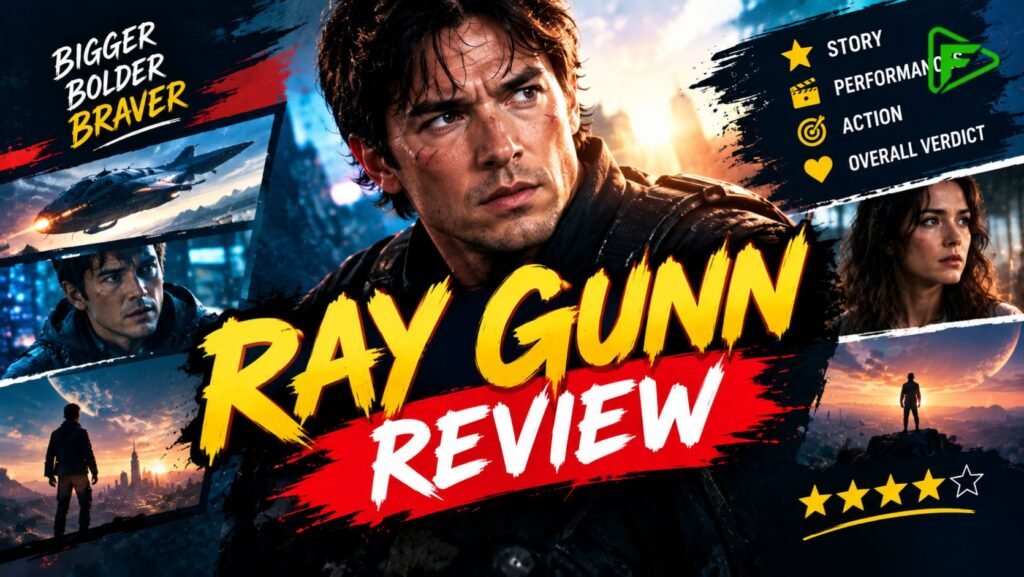
Ray Gunn Review: Brad Bird’s Animated Sci-Fi Noir Explained
Brad Bird’s Ray Gunn arrives with the ingredients of a memorable animated science-fiction film: a morally conflicted detective, a futuristic city drowning in corruption, an impressive voice cast, and an animation style that blends classic cartoon appeal with sophisticated visual design. Yet, despite its ambitious premise, the film never quite turns those strengths into a completely satisfying story.
Set in an alternate future, Ray Gunn follows a washed-up private investigator navigating the dangerous streets of Metropia, a city where technological progress has done little to eliminate prejudice, dishonesty, or the pursuit of power. Voiced by Sam Rockwell, Ray stands apart from the people around him because he refuses to abandon his personal code, even when the world seems determined to punish him for it.
His story intersects with Venus Nova, a music superstar voiced by Scarlett Johansson, as the film explores the uncomfortable relationship between personal integrity and a society that rewards people willing to compromise their principles. Aliens share this world with humans, but the unequal treatment they receive establishes an important undercurrent of discrimination and social division.
The result is an animated noir with considerably more on its mind than a conventional detective mystery. Unfortunately, as this Ray Gunn review explores, the film’s striking visuals and thoughtful themes are not always matched by equally strong storytelling.
What Is Ray Gunn About? Story, Setting, and Premise Explained
Ray Gunn is a futuristic animated detective story that combines elements of science fiction, crime fiction, and classic film noir. Rather than presenting a bright, optimistic vision of tomorrow, Brad Bird imagines a world where advanced technology exists alongside familiar human weaknesses. Corruption remains deeply rooted in society, social divisions continue to shape people’s lives, and doing the right thing can make someone appear foolish rather than admirable.
At the centre of this world is Ray, a private investigator whose old-fashioned moral code puts him at odds with the people around him. He is not presented as an untouchable action hero who can effortlessly solve every problem. Instead, his stubborn commitment to honesty makes him a complicated protagonist in an environment where manipulation and self-interest often seem more effective than integrity.
The presence of Venus Nova adds another dimension to the narrative. As a music superstar, she occupies a very different position in Metropia’s social hierarchy, giving the film opportunities to explore fame, public image, and the compromises that come with power. Their intersecting stories help connect the detective premise to the broader social commentary.
However, a compelling premise is only the beginning. The film introduces several mysteries and moral questions, but its twists do not consistently strengthen the characters or move the story forward. Some revelations feel less convincing than intended, making the final stretch less rewarding than the setup promises.
Brad Bird’s Animation Is the Film’s Biggest Achievement
One of the strongest reasons to watch Ray Gunn is its distinctive visual identity. Brad Bird has spent much of his career demonstrating how animation can combine expressive character design, carefully staged action, and cinematic storytelling. His experience on The Incredibles and Ratatouille is evident in the confidence with which he approaches this more mature science-fiction project.
The animation in Ray Gunn retains the exaggerated expressions and appealing character shapes associated with Bird’s earlier work, but gives them a more rounded, dimensional appearance. The result feels familiar without being an exact repetition of his previous films. Characters remain visually expressive, while the futuristic environment provides opportunities for more elaborate production design.
Metropia is particularly important to the film’s atmosphere. Its advanced technology and alien inhabitants establish a world that feels imaginative without losing the gritty atmosphere expected from a noir story. Rather than relying exclusively on conventional futuristic imagery, the film uses its setting to reinforce the uneasy relationship between progress and social inequality.
The alien designs also contribute to the film’s visual variety. Their presence makes the world feel larger than a typical human-centred detective story, while supporting the narrative’s examination of prejudice and exclusion.
Yet beautiful animation cannot solve every storytelling problem. There are moments when the film’s visual imagination feels more fully developed than its dramatic ideas. The world invites viewers to explore its possibilities, but the narrative does not always take full advantage of the setting it has created.
For fans of Brad Bird’s animated movies, Ray Gunn is still an interesting evolution of his style. Its greatest accomplishment is creating a visually engaging environment that feels worthy of a much stronger mystery.
Ray Gunn’s Noir Atmosphere Gives the Film Its Identity
Classic film noir frequently revolves around flawed protagonists, compromised institutions, dangerous secrets, and a world in which morality is rarely rewarded. Ray Gunn brings those familiar ingredients into a futuristic setting, using science-fiction elements to refresh a recognisable storytelling tradition.
Ray’s profession naturally places him in morally complicated situations. A private investigator must deal with people who conceal information, manipulate the truth, or attempt to use others for personal gain. In Metropia, these familiar problems exist alongside advanced technology and an unequal social structure, giving the film a contemporary edge beneath its retro-inspired detective framework.
The contrast between Ray’s principles and the surrounding corruption is one of the movie’s most interesting ideas. He belongs to a world that increasingly treats integrity as a disadvantage, yet he continues to hold on to his values. That conflict gives the character a potentially compelling emotional foundation.
The problem is that the film sometimes relies too heavily on its atmosphere to communicate the significance of its ideas. A morally complicated setting can establish a strong mood, but the characters still need convincing decisions and consequences to make that mood meaningful.
When the mystery introduces twists that undermine the apparent competence of its protagonist, the tension becomes less effective. Instead of making Ray’s world feel more unpredictable, certain developments weaken the audience’s investment in him.
This is where Ray Gunn falls short of the best animated crime stories. Its futuristic noir atmosphere is distinctive, but its detective narrative does not always deliver the precision and payoff that the genre demands.
The Voice Cast Brings Personality to Ray Gunn
The voice performances are among the film’s most consistent strengths. A character-driven animated story depends on more than visual expression; actors must also communicate personality, vulnerability, humour, and emotional conflict through dialogue alone. Ray Gunn benefits from a cast capable of bringing texture to its unusual characters.
Sam Rockwell as Ray Gunn
Sam Rockwell gives Ray a personality that extends beyond the familiar image of the cynical private investigator. His performance captures the character’s weariness while preserving the stubbornness that defines his moral outlook.
Ray is most interesting when his principles create genuine complications. His refusal to play by the rules of a corrupt society gives him an identifiable internal conflict, and Rockwell helps communicate the frustration of a man who understands how the world works but refuses to accept its values.
The writing does not always provide enough support for that performance. Some twists weaken the character’s apparent judgment, making it harder for his moral consistency to translate into consistently convincing detective work. Nevertheless, Rockwell gives the protagonist a strong foundation.
Scarlett Johansson as Venus Nova
Scarlett Johansson voices Venus Nova, a music superstar whose position in Metropia provides a contrast to Ray’s more disillusioned existence. The character introduces the pressures of celebrity culture into the film’s broader exploration of reputation, power, and personal compromise.
Johansson brings variety to the role, helping Venus feel like more than a supporting figure in Ray’s investigation. Her musical performance also contributes to the film’s entertainment value, particularly when the soundtrack allows the character’s identity to emerge through music.
Venus could have benefited from more consistently developed dramatic material, but Johansson makes her an engaging presence.
Tom Waits as Eye-Ra and Alan Tudyk’s Voice Work
Tom Waits adds character to Eye-Ra, a role that suits the distinctive quality of his voice. His contribution reinforces the film’s unusual atmosphere, where eccentric personalities help make Metropia feel like a place populated by individuals rather than generic figures in a futuristic backdrop.
Alan Tudyk also deserves recognition. His voice work adds another layer of personality to the ensemble, continuing a career in which vocal performance has been an important part of his work in animation.
Taken together, the Ray Gunn voice cast is one of the film’s clearest advantages. The performances give the characters individuality even when the screenplay struggles to make every plot development feel convincing.
Michael Giacchino’s Soundtrack Does Not Always Find Its Own Voice
A film with such a distinctive setting needs a soundtrack capable of supporting its atmosphere without simply repeating familiar musical ideas. Michael Giacchino, a frequent collaborator of Brad Bird, brings experience and technical confidence to Ray Gunn. However, parts of the score feel too reminiscent of his work on The Incredibles.
That resemblance is not automatically a problem. Musical collaborations often develop recognisable patterns, and familiar stylistic choices can help establish continuity between a director’s projects. The difficulty is that Ray Gunn has a substantially different tone and thematic focus.
Where The Incredibles balances superhero spectacle with family relationships and playful energy, Ray Gunn aims for something darker and more morally complicated. Its themes of corruption, discrimination, dishonesty, and personal integrity call for a soundscape that feels distinctly suited to its noir identity.
Some musical moments work well, and the film’s songs add personality to the world. Kimbra’s songwriting and Johansson’s vocals help create a more individual musical dimension, offering welcome variety beyond the score itself.
Still, the soundtrack does not consistently establish an identity as memorable as the film’s visual design. For a project built around a distinctive alternate future, the music could have done more to separate Metropia from the worlds Bird has explored before.
Ray Gunn’s Biggest Problem Is Its Uneven Storytelling
The central weakness of Ray Gunn is not a lack of ambition. The film has a strong premise, a distinctive setting, talented performers, and ideas that could support a substantial discussion about morality and prejudice. Its problem is the uneven relationship between those ambitions and the story used to express them.
The mystery introduces twists intended to challenge viewers’ assumptions, but several developments fail to deliver the impact they appear to be aiming for. A revelation can make an earlier scene more meaningful, expose a character’s weakness, or force the protagonist to reconsider his beliefs. In Ray Gunn, however, some twists feel more disruptive than illuminating.
This becomes particularly noticeable when the narrative undermines Ray’s competence. A flawed detective can be compelling, especially when his mistakes arise from pride, personal history, or an understandable misunderstanding. But when the plot weakens a character without providing a sufficiently persuasive explanation, the result can feel like an artificial obstacle rather than meaningful development.
The final act does not completely resolve these concerns. Although the film continues to pursue its larger themes, the emotional and narrative payoff is not always as satisfying as the premise suggests.
That does not make Ray Gunn a failure across the board. Its strongest sequences demonstrate the value of its setting and characters, and the film remains visually engaging. However, its storytelling prevents those elements from reaching their full potential.
Discrimination and Corruption: What Is Ray Gunn Trying to Say?
Beyond the detective mystery, Ray Gunn examines a society divided by prejudice and unequal treatment. Its depiction of aliens receiving less respect and care than humans introduces a clear social dimension to the futuristic setting.
The premise offers an opportunity to explore how discrimination becomes normalised. In an unequal society, injustice is not always expressed through dramatic acts of violence or open hostility. It can also appear in everyday assumptions, institutional decisions, and the belief that some groups deserve fewer opportunities than others.
Ray’s commitment to a personal moral code gives this theme a potential point of entry. His refusal to adopt the dishonest practices surrounding him suggests that individual choices still matter, even when the broader system remains corrupt.
The film also considers how easily integrity can be dismissed in a culture that rewards manipulation. This is a familiar moral conflict, but the science-fiction setting allows Bird to approach it through a world that is visually different from our own while remaining recognisable in its social tensions.
The difficulty is the way these ideas are delivered. The film sometimes makes its message so explicit that the characters and story lose room to communicate it naturally. Rather than allowing the moral conflict to emerge entirely through consequences and difficult choices, it occasionally pushes its intended meaning too forcefully.
This is the central contradiction of Ray Gunn: its themes are worth exploring, but its approach to communicating them is not always subtle enough to make them resonate. The film wants viewers to think about injustice and personal responsibility, yet its heavy-handed moments can diminish the emotional power of those ideas.
Is Ray Gunn Worth Watching?
For viewers who appreciate imaginative animation, unconventional science-fiction settings, and stories that attempt to explore more mature themes, Ray Gunn offers plenty to consider. Its visual design is a major attraction, while the voice cast gives the characters energy and individuality.
The film is particularly appealing to audiences interested in animated movies that move beyond straightforward family adventures. Its noir influences, morally conflicted detective, and depiction of a divided futuristic society give it a different identity from more conventional animated releases.
However, viewers expecting a tightly constructed mystery may find the experience less rewarding. The twists are uneven, the protagonist’s competence occasionally suffers, and the moral commentary sometimes feels more forceful than the storytelling can comfortably support.
Its strongest qualities make the film worth considering, but they do not erase the weaknesses in its narrative. Rather than becoming a fully realised animated noir classic, Ray Gunn remains an intriguing project that never quite reaches the heights suggested by its creative team.
For fans of Brad Bird, it is an interesting addition to his filmography. For viewers primarily interested in a gripping detective story, it may be a more qualified recommendation.
Ray Gunn Release Date: When Can You Watch It?
According to the release information provided for this review, Ray Gunn premiered at the 2026 London Film Festival. The film is scheduled for a limited theatrical release in the United States on December 4, 2026, followed by its Netflix streaming debut on December 18, 2026.
The Netflix release makes the film accessible to viewers who prefer watching animated science-fiction movies at home. However, streaming availability can vary by country, so viewers outside the United States should check their local Netflix catalogue for regional release information.
Because the streaming date is still in the future as of October 11, 2026, the film should not yet be described as available to stream.
Final Verdict: A Beautifully Animated Film That Cannot Fully Support Its Ambitions
Ray Gunn has the ingredients of a standout animated science-fiction movie. Brad Bird creates an imaginative alternate future, the animation has a distinctive visual appeal, and the voice cast gives the characters considerable personality. Its exploration of corruption, discrimination, and personal integrity also offers more thematic ambition than a straightforward detective adventure.
Unfortunately, the film’s uneven twists and heavy-handed moral commentary prevent those elements from coming together as effectively as they could. Its world is often more compelling than the mystery unfolding within it, and its message occasionally feels too obvious to carry the emotional weight the story demands.
The result is an ambitious but imperfect animated noir. Ray Gunn remains worth exploring for its artistry, performances, and ideas, but it stops short of delivering the fully satisfying experience its premise promises.
Our review takeaway: Ray Gunn is a visually impressive, thoughtfully conceived animated noir whose strong performances and ambitious themes are held back by uneven storytelling and an overly direct moral message.
Frequently Asked Questions About Ray Gunn
1. What is Ray Gunn about?
Ray Gunn is an animated science-fiction noir directed by Brad Bird. It follows a washed-up private investigator in the futuristic city of Metropia, where corruption, social division, and prejudice challenge his commitment to doing the right thing.
2. Who voices Ray Gunn?
Sam Rockwell voices the title character, a private investigator whose personal code puts him at odds with the corrupt world around him.
3. Who plays Venus Nova in Ray Gunn?
Scarlett Johansson voices Venus Nova, a music superstar whose story intersects with Ray’s. Her role also contributes to the film’s musical elements.
4. Who directed Ray Gunn?
Brad Bird directed Ray Gunn. He is known for animated films including The Incredibles and Ratatouille.
5. Is Ray Gunn a Netflix movie?
Yes. Netflix is the film’s planned streaming home. According to the supplied release information, its Netflix debut is scheduled for December 18, 2026.
6. When does Ray Gunn come out?
The supplied release schedule lists a limited US theatrical release for December 4, 2026, following its premiere at the 2026 London Film Festival. The Netflix streaming release is scheduled for December 18, 2026.
7. Is Ray Gunn worth watching?
If you enjoy visually distinctive animation, science-fiction noir, and stories exploring morality and discrimination, Ray Gunn may be worth watching. However, its uneven plot twists and sometimes heavy-handed messaging may disappoint viewers looking for a tightly written mystery.
8. What are the main themes of Ray Gunn?
The film explores personal integrity, corruption, discrimination, segregation, social inequality, and the compromises people make in their pursuit of power and success.
9. Who composed the music for Ray Gunn?
Michael Giacchino composed the score. The film also features musical elements connected to Scarlett Johansson’s vocals and songwriting by Kimbra.
10. Where does Ray Gunn take place?
The story is set in Metropia, an alternate-future city combining advanced technology, alien inhabitants, and a crime-ridden social environment shaped by corruption and inequality.
Stay updated with the latest trends on Fandomora — your go-to destination for breaking movie news, web series updates, anime releases, gaming trends, celebrity insights, and music updates. Explore reviews, OTT release dates, anime guides, gaming walkthroughs, and curated lists to discover the best in global entertainment.
About The Author