Steven Spielberg's Disclosure Day uses powerful visual symbolism—from darkness and silence to the open sky—to explore themes of truth, secrecy, and humanity's first contact with the unknown.
Steven Spielberg has never made science fiction that is only about aliens. Whether it’s Close Encounters of the Third Kind, E.T., A.I., or War of the Worlds, the extraterrestrial element usually serves as a mirror for humanity. Disclosure Day continues that tradition by layering its story with visual symbolism that many viewers may overlook on their first watch.
Instead of relying solely on dialogue, the film repeatedly uses locations, lighting, colors, silence, and recurring objects to explore truth, fear, secrecy, and the cost of knowledge.
Warning: Major spoilers ahead.
1. The Meaning of “Disclosure”
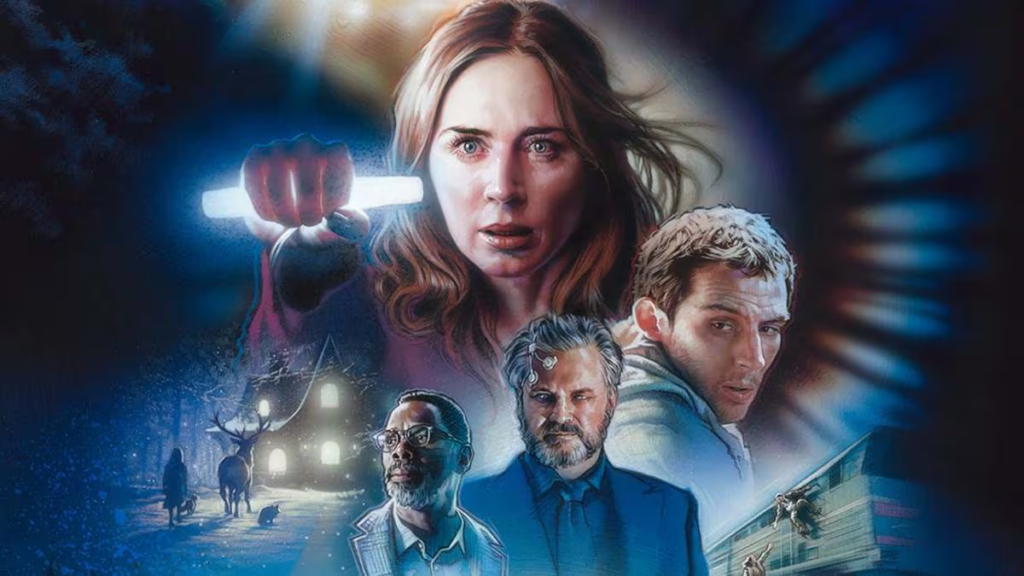
The title itself is the film’s first symbol.
At first glance, “Disclosure” appears to refer to revealing the existence of extraterrestrial life. But as the story unfolds, it becomes clear that the film asks a broader question:
Can humanity handle the truth?
The “disclosure” is not just about aliens—it is about exposing everything institutions hide from the public in the name of security, stability, or control.
Throughout the movie, the greatest conflict isn’t between humans and an unknown intelligence. It’s between transparency and secrecy.
2. Darkness vs. Light

One of the film’s most consistent visual motifs is the contrast between darkness and light.
Many pivotal conversations take place in dimly lit rooms, underground facilities, or shadow-filled corridors. These spaces symbolize uncertainty, misinformation, and controlled narratives.
As more truths emerge, scenes gradually become brighter, more open, and visually expansive.
Spielberg appears to use lighting as a metaphor for knowledge itself.
Darkness doesn’t necessarily represent evil—it represents ignorance.
3. Windows and Glass
Characters are repeatedly framed through windows, glass panels, observation rooms, and reflective surfaces.
Glass is symbolic because it allows people to see without fully participating.
Governments observe.
Scientists observe.
Citizens observe.
Yet almost nobody fully understands what they’re seeing.
Glass also creates distorted reflections, suggesting that perception is rarely identical to reality.
4. Silence as a Character
One of the film’s boldest choices is how often it embraces silence.
Instead of filling every dramatic moment with dialogue, Spielberg frequently allows quiet scenes to dominate.
Silence becomes symbolic of the unknown.
It forces audiences to experience uncertainty alongside the characters rather than being told exactly what to think.
This technique recalls classic science-fiction cinema, where mystery was often more powerful than explanation.
5. The Sky Isn’t Just a Setting
Throughout the movie, characters repeatedly look upward.
This isn’t merely because something is happening in the sky.
The upward gaze symbolizes humanity’s oldest instinct:
Looking beyond ourselves for answers.
Across civilizations, the heavens have represented religion, destiny, hope, and fear.
By constantly directing the audience’s attention upward, the film reminds us that humanity has always searched for meaning beyond Earth.
6. Doors and Thresholds
Characters repeatedly approach secured doors, restricted areas, checkpoints, and sealed rooms.
These physical barriers symbolize intellectual barriers.
Every door crossed represents another uncomfortable truth.
The closer characters get to complete understanding, the more difficult those doors become to open.
The film quietly suggests that knowledge always has a cost.
7. Communication Over Conflict
Unlike many modern alien films that prioritize battles and explosions, Disclosure Day repeatedly emphasizes communication.
Whether through scientific observation, coded signals, or careful dialogue, understanding becomes more important than domination.
This reflects one of Spielberg’s recurring beliefs:
Fear comes from misunderstanding.
Communication reduces fear.
8. The Human Crowd
Large crowds appear throughout the film, often reacting before they fully understand what’s happening.
Collectively, these scenes symbolize how societies process uncertainty.
Rumors spread faster than facts.
Panic often outruns evidence.
The film subtly critiques humanity’s tendency to choose emotional certainty over patient investigation.
9. The Color Palette
The movie’s muted blues, grays, and cold metallic tones create a world that feels emotionally restrained.
These colors reinforce themes of institutional control, secrecy, and isolation.
Whenever warmer colors appear, they usually coincide with moments of empathy, family, or personal connection.
The contrast suggests that while governments manage information, individuals preserve humanity.
10. The Ending’s Biggest Symbol
Perhaps the film’s most misunderstood symbol is its ending.
Many viewers expected a massive revelation or spectacle.
Instead, Spielberg leaves audiences with ambiguity.
This choice appears intentional.
The ultimate message isn’t that every mystery deserves complete explanation.
Sometimes humanity changes simply because it begins asking better questions.
The ending transforms “disclosure” from an event into a process.
Truth isn’t a single announcement.
It’s an ongoing journey.
Final Interpretation
Viewed purely as an alien thriller, Disclosure Day may feel restrained compared to modern blockbusters.
Viewed symbolically, however, the film becomes a meditation on truth, fear, institutional secrecy, and humanity’s desire to understand the unknown.
Every recurring image—from glass and darkness to silence and the open sky—reinforces the same central idea:
The greatest mystery isn’t whether we’re alone in the universe. It’s whether we’re ready to confront the truth when it finally arrives.
That thematic focus makes Disclosure Day less about extraterrestrials and more about ourselves—a hallmark of Spielberg’s most enduring science-fiction stories.
Stay updated with the latest trends on Fandomora — your go-to destination for breaking movie news, web series updates, anime releases, gaming trends, celebrity insights, and music updates. Explore reviews, OTT release dates, anime guides, gaming walkthroughs, and curated lists to discover the best in global entertainment.
About The Author