Introduction
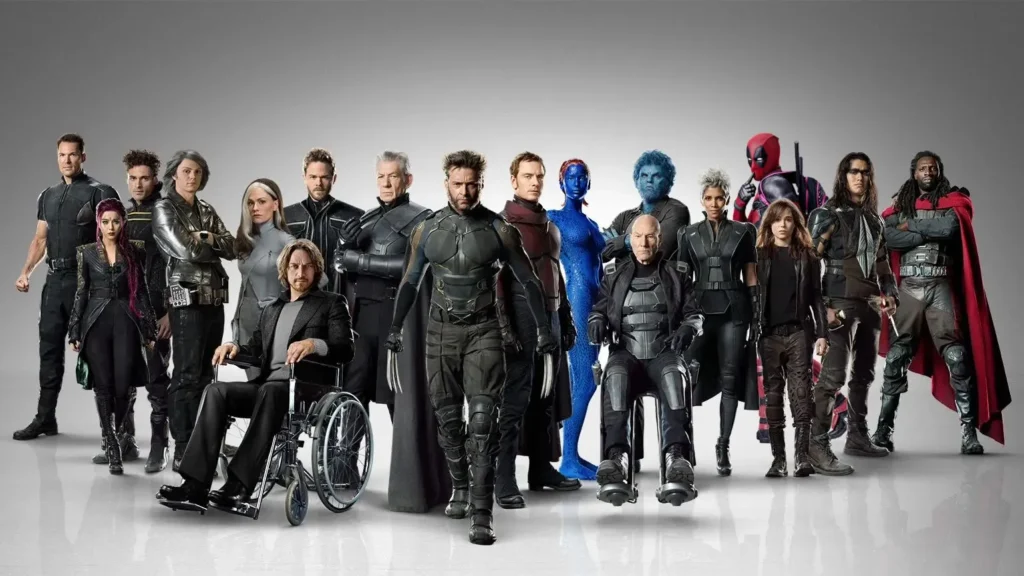
Few superhero franchises have had as much influence on modern comic-book cinema as the X-Men series. Long before superhero movies became Hollywood’s biggest genre, the mutants from Marvel Comics proved that audiences were ready for stories that combined action, emotional depth, and thought-provoking themes. Since the first film arrived in 2000, the franchise has grown into a collection of interconnected stories featuring legendary heroes, unforgettable villains, and multiple timelines that span decades.
Unlike many superhero franchises that follow a straightforward sequence, the X-Men movies jump across different eras, introduce alternate timelines, and include several spin-offs centered on popular characters like Wolverine and Deadpool. That makes deciding where to begin a challenge for both new viewers and longtime fans returning to the series.
Whether you’re planning your first marathon or revisiting the franchise before the X-Men officially become a major part of the Marvel Cinematic Universe, understanding the correct viewing order makes every character arc and storyline easier to follow. Both release order and chronological order offer unique experiences, and choosing the right one depends on how you want the story to unfold.
How Many X-Men Movies Are There?
As of 2026, there are 13 live-action movies connected to the Fox X-Men universe. These films include the original trilogy, the prequel series, Wolverine’s standalone adventures, the two Deadpool movies released under Fox, and The New Mutants.
Although all of these movies belong to the broader X-Men universe, they don’t follow a single uninterrupted timeline. Events in later films, particularly X-Men: Days of Future Past, reshape the continuity and create alternate versions of history. This means that some characters experience different futures depending on which timeline is being followed.
For most viewers, the easiest way to enjoy the franchise is to start with the order in which the movies were released before exploring the chronological timeline.
X-Men Movies in Release Order
Watching the X-Men films in release order remains the best option for first-time viewers. This approach allows major twists, character introductions, and emotional moments to unfold exactly as filmmakers originally intended. It also makes it easier to appreciate how the franchise evolved over two decades, from its grounded beginnings to the larger multiverse stories introduced later.
1. X-Men (2000)
The first X-Men movie changed the superhero genre forever. At a time when comic-book films were still finding their identity, director Bryan Singer delivered a grounded and character-driven story that introduced audiences to a world where mutants were feared simply because they were different.
The film follows Wolverine and Rogue as they become involved with Professor Charles Xavier’s School for Gifted Youngsters while Magneto prepares a plan that could change the relationship between mutants and humans forever.
More than just an origin story, X-Men establishes the philosophical conflict that drives the entire franchise. Professor Xavier believes peaceful coexistence is possible, while Magneto argues that mutants must protect themselves before humanity turns against them. That ideological battle becomes the emotional foundation for nearly every sequel that follows.
Despite its relatively modest budget by today’s standards, the movie remains an important milestone in superhero cinema thanks to its memorable performances, thoughtful storytelling, and iconic introduction to characters who would become fan favorites.
2. X2: X-Men United (2003)
Widely regarded as one of the greatest superhero sequels ever made, X2: X-Men United expands every aspect of the original film. The stakes become larger, the action more ambitious, and the characters far more emotionally complex.
When Colonel William Stryker launches an attack against mutants, the X-Men are forced into an uneasy alliance with Magneto to stop a threat that endangers everyone. This unexpected partnership creates some of the franchise’s strongest character moments while exploring deeper questions about prejudice, trust, and sacrifice.
The film also delves further into Wolverine’s mysterious past, laying the groundwork for future stories centered on his origins. At the same time, characters such as Nightcrawler make unforgettable first impressions, adding new energy to the growing ensemble.
Even more than twenty years after its release, X2 remains one of the defining entries in the superhero genre because it balances spectacular action with meaningful character development.
3. X-Men: The Last Stand (2006)
The original trilogy concludes with X-Men: The Last Stand, a film that adapts elements of Marvel’s famous Dark Phoenix storyline while introducing a controversial mutant cure capable of permanently removing mutant abilities.
The discovery of the cure forces every mutant to confront difficult personal choices. Some view it as a chance to live ordinary lives, while others see it as an attack on their identity. This moral conflict creates tension not only between humans and mutants but also within the mutant community itself.
At the center of the story is Jean Grey, whose transformation into the immensely powerful Phoenix threatens both her closest friends and the future of the X-Men.
Although fan opinions remain divided over some creative decisions, the movie delivers several emotional moments that have lasting consequences for many of the franchise’s most important characters.
4. X-Men Origins: Wolverine (2009)
After becoming the franchise’s breakout star, Wolverine received his first solo adventure in X-Men Origins: Wolverine.
The film explores Logan’s early life, his relationship with his half-brother Victor Creed, and the events that ultimately lead to the Weapon X experiment, where his skeleton is bonded with virtually indestructible adamantium.
Set across multiple historical conflicts, the story attempts to explain many of Wolverine’s defining traits, including his memory loss, extraordinary healing ability, and complicated relationship with military organizations.
While the film received mixed reviews, it remains an important chapter for viewers interested in Wolverine’s personal history and the origins of one of Marvel’s most recognizable heroes.
5. X-Men: First Class (2011)
Rather than continuing the existing storyline, X-Men: First Class takes audiences back to the 1960s and reimagines the early friendship between Charles Xavier and Erik Lehnsherr before they became Professor X and Magneto.
Against the backdrop of the Cold War, the two gifted mutants work together to prevent a global catastrophe while recruiting the first generation of X-Men. Their partnership is built on mutual respect, but their contrasting beliefs about humanity slowly push them toward opposite sides of the conflict.
The film introduces younger versions of many familiar characters while offering a fresh visual style and a stronger focus on character relationships. It successfully revitalized the franchise and laid the foundation for the interconnected prequel timeline that followed.
Many fans consider First Class one of the strongest entries in the series because it combines historical events, emotional storytelling, and exciting superhero action into a compelling origin story.
6. The Wolverine (2013)
Set after the events of X-Men: The Last Stand, The Wolverine follows Logan as he travels to Japan after receiving an unexpected invitation from a man whose life he saved decades earlier.
Haunted by personal loss and questioning his purpose, Wolverine finds himself drawn into a deadly conflict involving powerful corporations, ancient family rivalries, and dangerous new enemies.
Unlike many superhero movies, The Wolverine emphasizes character growth over large-scale spectacle. It explores Logan’s vulnerability, mortality, and emotional struggles while placing him in unfamiliar surroundings that challenge both his physical and mental strength.
The film also contains a post-credit scene that directly sets up the events of X-Men: Days of Future Past, making it an important bridge between different chapters of the franchise.
7. X-Men: Days of Future Past (2014)
Few superhero films have reshaped an entire franchise as successfully as X-Men: Days of Future Past. Based loosely on the iconic Marvel Comics storyline of the same name, the movie brings together the original X-Men cast and the younger team introduced in First Class, creating one of the most ambitious crossover events in superhero cinema.
The story begins in a bleak future where powerful mutant-hunting robots known as Sentinels have pushed both humans and mutants to the brink of extinction. In a desperate attempt to prevent this future, Wolverine is sent back to 1973 to change a single event that altered history forever.
Rather than relying solely on action, the film explores themes of redemption, forgiveness, and second chances. Charles Xavier struggles with self-doubt, Magneto remains convinced that force is the only path to survival, and Mystique becomes the key to humanity’s future.
Perhaps the film’s greatest achievement is how it resets the X-Men timeline without completely abandoning what came before. By changing history, Days of Future Past creates a fresh continuity that allows later movies to tell new stories while honoring the franchise’s legacy.
For many fans, it remains the best X-Men movie ever made.
8. Deadpool (2016)
After years of fan demand, Deadpool finally arrived with a completely different approach to superhero storytelling. Instead of following traditional comic-book conventions, the film embraced R-rated humor, graphic action, and constant fourth-wall breaks, perfectly capturing the personality of Wade Wilson from Marvel Comics.
Ryan Reynolds delivers a career-defining performance as the wisecracking mercenary whose experimental treatment leaves him with accelerated healing abilities—and a permanently scarred appearance. Rather than becoming a conventional superhero, Deadpool sets out on a chaotic mission of revenge while refusing to take himself or the genre too seriously.
Although the movie exists within the broader X-Men universe, it intentionally pokes fun at its own continuity. References to Professor X, the X-Mansion, and several mutant characters firmly connect it to the franchise, even as the film satirizes superhero clichés.
Its enormous critical and commercial success proved that comic-book adaptations could succeed with mature storytelling, opening the door for more ambitious R-rated superhero films in the years that followed.
9. X-Men: Apocalypse (2016)
Following the events of Days of Future Past, X-Men: Apocalypse introduces one of Marvel’s oldest and most powerful mutants. After awakening from a centuries-long slumber, Apocalypse believes modern civilization has lost its way and decides to rebuild the world through destruction.
The film expands the younger X-Men roster by introducing new versions of Cyclops, Jean Grey, Storm, and Nightcrawler while continuing the evolving relationships between Professor X, Magneto, Mystique, and Beast.
One of the movie’s strongest elements is Magneto’s emotional storyline, which explores the devastating personal loss that once again pushes him toward violence. His internal conflict adds emotional weight to a film centered on world-ending stakes.
While opinions on Apocalypse as a villain remain mixed, the movie successfully develops the younger generation of mutants who become central figures in the franchise’s later entries.
10. Logan (2017)
More than just another superhero movie, Logan stands as one of the finest comic-book adaptations ever produced.
Set in a possible future where mutants have nearly disappeared, the film follows an aging Wolverine whose healing abilities are fading. Living in isolation while caring for an elderly Charles Xavier, Logan is forced back into action after meeting a young mutant whose abilities mirror his own.
Instead of focusing on large-scale battles, the story explores mortality, family, redemption, and legacy. Hugh Jackman delivers one of the strongest performances of his career, portraying a hero who is physically exhausted but emotionally determined to protect the next generation.
The relationship between Logan and Laura, also known as X-23, forms the emotional core of the movie. Their journey transforms what could have been a traditional action film into a deeply moving story about sacrifice and hope.
For many critics and fans, Logan remains the definitive Wolverine movie and one of the greatest superhero films ever made.
11. Deadpool 2 (2018)
Building on the success of the original, Deadpool 2 delivers even bigger action, sharper comedy, and surprising emotional depth.
The sequel introduces Cable, a time-traveling soldier determined to stop a dangerous young mutant from becoming a future threat. Rather than simply fighting Cable, Deadpool forms the hilariously dysfunctional X-Force team while learning difficult lessons about responsibility, family, and personal growth.
Although the movie retains its signature humor and relentless pop-culture references, it also develops Wade Wilson beyond his sarcastic persona. His evolving relationships give the sequel greater emotional impact without sacrificing the comedy that made the original so popular.
The film further expands the X-Men universe while continuing to blur the line between superhero adventure and parody.
12. Dark Phoenix (2019)
Dark Phoenix revisits one of Marvel’s most famous comic-book storylines, focusing on Jean Grey’s struggle to control an unimaginable cosmic force.
Set in the 1990s, the story follows the X-Men as a rescue mission in space exposes Jean to mysterious energy that amplifies her already extraordinary telepathic and telekinetic abilities. As her powers spiral beyond her control, longtime friendships are tested and difficult choices become unavoidable.
Unlike the larger ensemble adventures that preceded it, Dark Phoenix centers primarily on Jean’s emotional journey and the consequences of unchecked power.
Although the film received mixed reviews, it serves as the final chapter of Fox’s main X-Men saga before Marvel Studios regained the rights to the characters.
13. The New Mutants (2020)
The final film produced within Fox’s X-Men universe takes a very different approach.
Rather than presenting another superhero epic, The New Mutants blends psychological horror with coming-of-age storytelling. A group of young mutants awakens inside a mysterious medical facility where they must confront both external threats and their deepest personal fears.
Each character struggles with trauma, guilt, and identity while gradually learning to control extraordinary abilities.
Although largely disconnected from the main X-Men storyline, the film expands the mutant universe by exploring younger heroes whose stories differ significantly from traditional superhero adventures.
Its horror-inspired atmosphere gives it a unique identity within the franchise.
X-Men Movies in Chronological Order
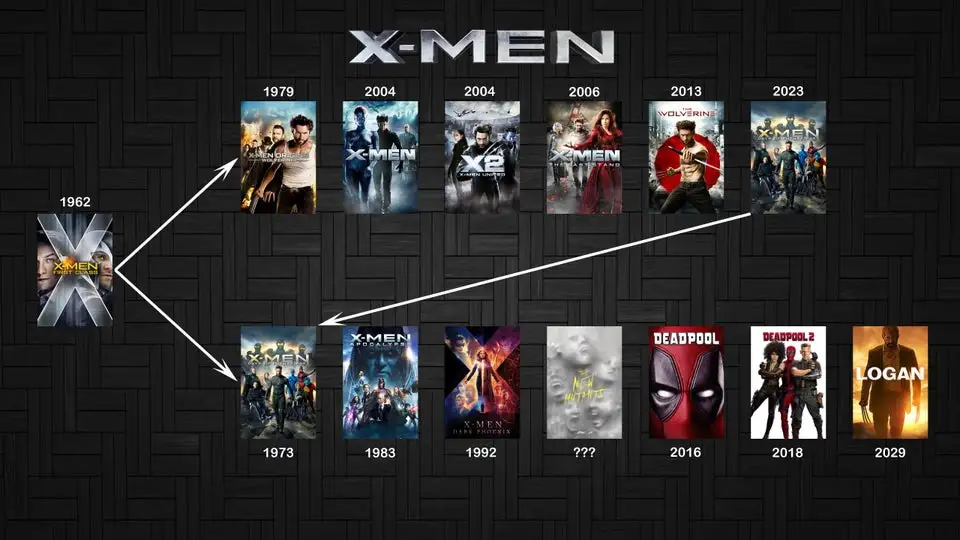
For viewers interested in following the events as they occur within the fictional timeline, the chronological order differs significantly from the release schedule.
The recommended chronological viewing order is:
- X-Men: First Class (1962)
- X-Men: Days of Future Past (1973 timeline)
- X-Men Origins: Wolverine
- X-Men: Apocalypse
- Dark Phoenix
- X-Men
- X2: X-Men United
- X-Men: The Last Stand
- The Wolverine
- Deadpool
- Deadpool 2
- The New Mutants
- Logan
Because time travel creates alternate realities, some events overlap or contradict one another. This is an intentional part of the franchise rather than a viewing mistake.
Why the X-Men Timeline Is So Confusing
The X-Men universe follows two major continuities.
The original trilogy established one version of history, but Days of Future Past fundamentally changes that timeline after Wolverine prevents key historical events from occurring. This creates a revised continuity in which several characters experience completely different futures.
Rather than viewing the inconsistencies as plot holes, it’s more accurate to think of the franchise as multiple timelines existing within the same multiverse. This interpretation has become even more relevant following Marvel’s introduction of the multiverse in the MCU.
Should You Watch the X-Men Movies in Release Order or Chronological Order?
For newcomers, release order remains the strongest recommendation.
Watching the films in the order they premiered allows character relationships, surprises, and major story developments to unfold naturally. It also avoids confusion caused by timeline changes introduced later in the series.
Chronological order is better suited for viewers who have already experienced the franchise and want to see how the fictional history unfolds from beginning to end.
Neither approach is wrong, but release order provides the most satisfying first experience.
Will the X-Men Join the MCU?
The future of the X-Men has never looked more exciting.
With Marvel Studios now controlling the mutant characters, the X-Men are expected to play a major role in the next era of the Marvel Cinematic Universe. Several legacy characters have already appeared through multiverse stories, hinting at a much larger introduction in future Marvel projects.
Although Marvel has not yet revealed the full roster or storyline for its rebooted X-Men, anticipation continues to grow as the studio prepares to introduce mutants into its shared cinematic universe.
Final Verdict
More than twenty years after the franchise began, the X-Men movies continue to stand among the most influential superhero films ever produced. Their combination of action, emotional storytelling, memorable performances, and timeless themes has helped them remain relevant across multiple generations of moviegoers.
For anyone experiencing the series for the first time, following the release order offers the most rewarding journey, allowing every major reveal and character arc to unfold exactly as intended. Returning fans may enjoy exploring the chronological timeline to gain a fresh perspective on how the story evolves across different eras and alternate realities.
Whether your favorite hero is Wolverine, Professor X, Magneto, Deadpool, or the next generation of mutants, the X-Men franchise remains an essential part of superhero cinema—and the perfect foundation for the mutants’ future in the Marvel Cinematic Universe.
Stay updated with the latest trends on Fandomora — your go-to destination for breaking movie news, web series updates, anime releases, gaming trends, celebrity insights, and music updates. Explore reviews, OTT release dates, anime guides, gaming walkthroughs, and curated lists to discover the best in global entertainment.
About The Author