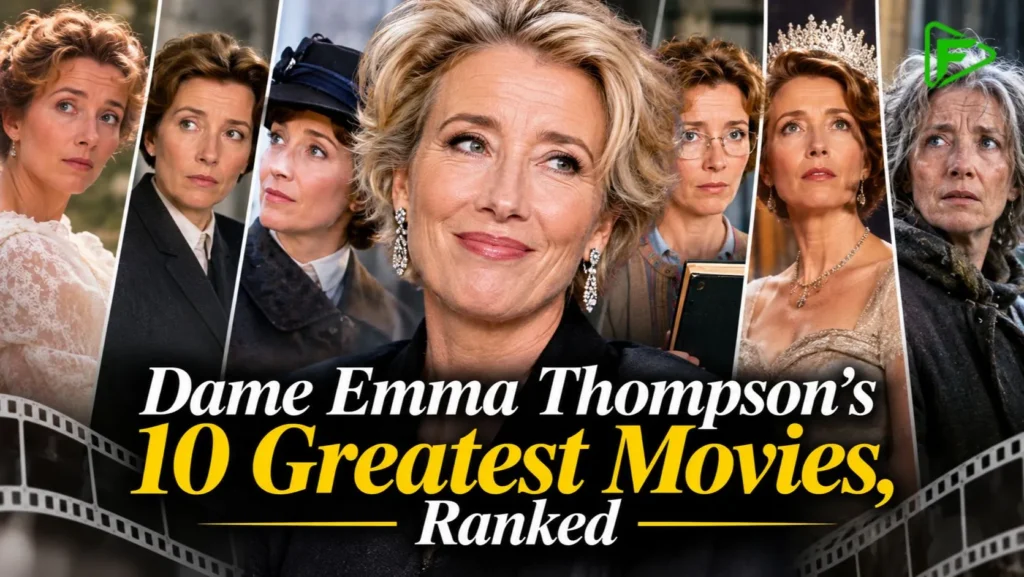
Dame Emma Thompson's Best Movies: 10 Greatest Ranked
Dame Emma Thompson has built a film career that refuses to fit neatly into one category. She can bring emotional restraint to a literary period drama, deliver sharp comedy without making a character feel cartoonish, and turn an apparently ordinary scene into something audiences remember long after the credits roll. Her performances are often defined by intelligence, warmth and a remarkable ability to communicate what a character is trying not to say.
The British actress and screenwriter has delivered acclaimed performances in films such as Howards End, Sense and Sensibility, The Remains of the Day, Love Actually and Saving Mr. Banks. She has also moved comfortably between prestige dramas, romantic comedies, fantasy films, animation and mainstream franchises. Her career includes two Academy Awards, one for acting and another for screenwriting, a rare achievement that reflects how much of her talent extends beyond performing.
But which movies represent her best work?
From emotionally devastating dramas to crowd-pleasing comedies, these are Emma Thompson’s 10 greatest movies, ranked, considering the strength of her performance, the quality of the film and its lasting significance to her career.
10. Cruella (2021)
Director: Craig Gillespie
Genre: Crime, Comedy, Drama
Emma Thompson’s role: The Baroness
Cruella gives Emma Thompson the opportunity to play a character who is every bit as theatrical, ruthless and fashion-obsessed as the movie’s central protagonist. Set in 1970s London, the Disney film follows Estella, a young aspiring fashion designer whose ambition eventually transforms her into the rebellious Cruella de Vil.
Thompson plays the Baroness, an influential fashion designer who initially appears to be Estella’s professional idol. That admiration quickly turns into a complicated rivalry as Estella begins challenging the Baroness’s authority and discovers secrets that change her understanding of her own past.
The Baroness is a character who thrives on power, intimidation and control. Thompson makes her frightening without relying on exaggerated villain theatrics. Her expressions, dismissive attitude and carefully calculated cruelty create a character who can dominate a room without raising her voice.
The film’s strongest element is the battle between its two fashion-focused personalities. Emma Thompson’s Baroness represents established power and privilege, while Estella embodies rebellion and the desire to create something new.
Although Cruella isn’t among Thompson’s most emotionally complex performances, it demonstrates her ability to play a formidable antagonist in a modern studio production. Her presence gives the movie a stronger dramatic centre and makes the rivalry more engaging.
9. Love Actually (2003)
Director: Richard Curtis
Genre: Romantic Comedy
Emma Thompson’s role: Karen
Love Actually remains one of the most frequently revisited Christmas movies, but Emma Thompson‘s performance as Karen is one of the reasons the film still resonates beyond its seasonal reputation.
Karen is married to Harry, played by Alan Rickman, and appears to have a comfortable family life. However, she begins suspecting that her husband is emotionally involved with another woman. The story explores the painful consequences of betrayal while the film’s other characters experience their own romantic complications.
Thompson brings an understated emotional realism to Karen. Rather than making her reaction unnecessarily dramatic, she portrays a woman trying to maintain her dignity while processing a devastating personal discovery.
One of the movie’s most memorable moments involves Karen quietly confronting the reality of her husband’s behaviour. Thompson communicates heartbreak through a restrained performance, allowing the audience to understand her pain without requiring a long speech.
The scene is often remembered as one of the film’s most emotionally powerful moments because it captures the private devastation that can exist beneath an apparently normal family life.
Love Actually is a comedy with multiple storylines, but Thompson’s performance gives it a grounded emotional perspective. Her work is a reminder that a character doesn’t need to dominate screen time to leave a lasting impression.
8. Stranger Than Fiction (2006)
Director: Marc Forster
Genre: Fantasy, Comedy, Drama
Emma Thompson’s role: Karen Eiffel
Stranger Than Fiction is one of the most unusual films in Emma Thompson’s filmography. It follows Harold Crick, an ordinary tax inspector who begins hearing a narrator describing his life. The voice belongs to a novelist named Karen Eiffel, who is writing a book about him without realising that her fictional character may actually be a real person.
Thompson plays Karen as an intelligent but emotionally troubled writer struggling to complete her novel. She has become so focused on her work that she has difficulty separating the story she is creating from the real consequences of her decisions.
The film’s premise creates a fascinating conflict between the writer and the person whose life she is controlling. Karen must confront the possibility that the ending she has planned for her novel could have consequences beyond the page.
Thompson balances the character’s dry humour with a genuine sense of uncertainty. Karen isn’t presented as a conventional villain, even though her decisions could determine another person’s fate. Instead, she becomes a complicated creative figure wrestling with the responsibility of storytelling.
The movie also benefits from an unusual combination of comedy, philosophical questions and emotional drama. Its concept may initially seem strange, but it gradually develops into a story about mortality, creativity and the importance of making choices.
For Thompson, the role demonstrates her ability to make a character’s internal conflict feel believable even when the film operates within an unconventional fantasy premise.
7. Saving Mr. Banks (2013)
Director: John Lee Hancock
Genre: Biographical Drama
Emma Thompson’s role: P. L. Travers
Saving Mr. Banks explores the complicated relationship between author P. L. Travers and Walt Disney during the development of the film adaptation of Mary Poppins. Travers initially resists Disney’s efforts to bring her beloved character to the screen, and the movie examines the personal experiences that shaped her attachment to the story.
Thompson plays Travers as a fiercely protective author who refuses to compromise easily. She is stubborn, emotionally guarded and frequently difficult to work with, but the film gradually reveals the reasons behind her behaviour.
The performance is particularly effective because Thompson doesn’t attempt to make Travers universally likeable. Her character can be frustrating, dismissive and uncompromising, yet there is an emotional vulnerability beneath that exterior.
The movie alternates between Travers’s negotiations with Disney and memories of her childhood, helping explain why Mary Poppins means so much to her. Thompson’s portrayal holds these different layers together, allowing the audience to understand the character without excusing every decision she makes.
Her chemistry with Tom Hanks, who plays Walt Disney, creates an engaging contrast between two people with very different approaches to storytelling. Disney is optimistic about adaptation, while Travers believes that changing her work means losing something essential.
Saving Mr. Banks is one of Thompson’s strongest later-career performances because it combines comedy, emotional drama and character development. It also highlights her ability to play real people without turning them into simplistic biographical portraits.
6. The Children Act (2017)
Director: Richard Eyre
Genre: Drama
Emma Thompson’s role: Fiona Maye
The Children Act is a quietly powerful legal drama built around a difficult ethical question. Fiona Maye is a respected High Court judge whose professional responsibilities become intertwined with a personal crisis when her marriage begins falling apart.
At the same time, she must decide whether a teenage boy suffering from leukaemia should receive a life-saving blood transfusion against the wishes of his religious parents.
Thompson’s performance is the centre of the film. Fiona is intelligent, controlled and accustomed to making decisions that affect other people’s lives. But the story gradually reveals how difficult it is for her to maintain that professional distance when she becomes personally involved in the case.
The movie doesn’t offer easy answers. It explores the tension between religious belief, medical necessity, parental authority and the responsibility of the legal system to protect a child’s welfare.
Thompson makes Fiona’s internal conflict believable through small changes in expression and behaviour. Her character’s emotional struggle is often visible in the moments when she appears to be trying hardest to remain composed.
The role is particularly strong because it doesn’t depend on dramatic courtroom speeches. Fiona’s authority comes from her intelligence and careful reasoning, while her personal vulnerability gives the story its emotional weight.
For viewers interested in Emma Thompson’s serious dramatic work, The Children Act deserves considerably more attention than some of her better-known mainstream films.
5. In the Name of the Father (1993)
Director: Jim Sheridan
Genre: Biographical Drama
Emma Thompson’s role: Gareth Peirce
In the Name of the Father is one of the most important films in Thompson’s early filmography. Based on the story of Gerry Conlon and the Guildford Four, the drama examines wrongful convictions connected to the 1974 Guildford pub bombings.
Daniel Day-Lewis plays Gerry Conlon, a young man who is wrongly accused and convicted. Thompson portrays Gareth Peirce, the lawyer who works to challenge the convictions and expose the flaws in the case.
The movie is emotionally charged, exploring injustice, institutional failure, family relationships and the consequences of wrongful imprisonment. It is a difficult watch at times, but its central story remains powerful.
Thompson’s performance is relatively restrained compared with some of the film’s more emotionally explosive scenes. That restraint works in her favour. Peirce is a lawyer whose determination is expressed through persistence, intelligence and a refusal to accept an unjust outcome.
Her role also demonstrates how Thompson can bring strength to a character without making that strength overly theatrical. She conveys conviction through her presence and the way she approaches the case.
The film remains one of the strongest examples of Thompson’s ability to work within serious historical drama. It is also a reminder that her career has consistently included stories concerned with social issues and the consequences of institutional power.
4. Much Ado About Nothing (1993)
Director: Kenneth Branagh
Genre: Romantic Comedy, Shakespeare Adaptation
Emma Thompson’s role: Beatrice
Kenneth Branagh’s Much Ado About Nothing is a lively adaptation of William Shakespeare’s comedy about love, misunderstandings, deception and the complicated relationship between Beatrice and Benedick.
Thompson plays Beatrice, a sharp-witted woman who refuses to accept the conventional expectations placed on her. She is intelligent, outspoken and frequently sarcastic, especially when interacting with Benedick, played by Branagh.
Their relationship is built around verbal sparring. Both characters are reluctant to admit that they have feelings for each other, and the film’s comedy comes from their attempts to hide their attraction behind arguments and jokes.
Thompson’s performance is particularly effective because she understands the rhythm of Shakespearean dialogue. Her delivery feels lively and natural rather than overly formal, allowing the character’s humour and personality to come through.
The movie also benefits from its ensemble cast, colourful setting and energetic approach to the source material. It captures the romantic comedy elements of Shakespeare’s play while maintaining a strong sense of theatricality.
Beatrice is one of Thompson’s most memorable characters because she combines confidence, wit and emotional vulnerability. Her performance demonstrates how the actress can make classical material accessible without sacrificing its literary qualities.
3. Howards End (1992)
Director: James Ivory
Genre: Period Drama
Emma Thompson’s role: Margaret Schlegel
Howards End is one of the films that established Emma Thompson as one of the most respected dramatic actresses of her generation. Adapted from E. M. Forster’s novel, the film explores social class, relationships, inheritance and the changing nature of British society in the early 20th century.
Thompson plays Margaret Schlegel, an intelligent and thoughtful woman whose friendship with the Wilcox family becomes increasingly complicated. The story centres on the titular house, Howards End, which becomes a symbol of class divisions and conflicting ideas about family, property and social responsibility.
Margaret is not a character defined by dramatic outbursts. Her strength comes from her ability to understand people, recognise contradictions and navigate complicated social relationships.
Thompson’s performance captures the character’s warmth, intelligence and emotional restraint. She brings a subtle quality to the role that makes Margaret feel like a person who is constantly thinking about the world around her rather than simply reacting to it.
The film’s elegant direction, thoughtful performances and literary depth make it one of the defining British period dramas of its era. Thompson’s work is especially memorable because she gives the character a strong emotional centre without overwhelming the film’s ensemble.
Howards End remains essential viewing for anyone interested in the actress’s early career and her ability to lead a sophisticated literary adaptation.
2. The Remains of the Day (1993)
Director: James Ivory
Genre: Drama, Romance
Emma Thompson’s role: Miss Kenton
The Remains of the Day is one of the most emotionally devastating films in Emma Thompson’s career. The story follows Stevens, a devoted English butler played by Anthony Hopkins, whose professional commitment has prevented him from fully engaging with his personal life.
Thompson plays Miss Kenton, the housekeeper who works alongside Stevens at Darlington Hall. Their relationship develops over time, but both characters struggle to express their feelings because of their professional responsibilities and emotional restraint.
The film’s tragedy is not built around a major dramatic event. Instead, it comes from the choices the characters make, the opportunities they miss and the feelings they never fully acknowledge.
Thompson’s performance is particularly powerful because Miss Kenton is a character who wants something more from life but gradually becomes aware that the possibility of achieving it may be slipping away.
Her interactions with Hopkins are filled with subtle emotional tension. The characters often communicate through formal conversations, yet the audience can sense the affection and frustration beneath their words.
The movie explores regret, duty, class and the cost of allowing professional identity to become the centre of one’s existence. Thompson’s performance adds warmth and emotional depth to a story that is otherwise deliberately restrained.
It is one of her finest dramatic roles and a film that deserves to be ranked among the greatest works of both Thompson and Anthony Hopkins.
1. Sense and Sensibility (1995)
Director: Ang Lee
Genre: Romantic Drama, Period Drama
Emma Thompson’s role: Elinor Dashwood
Screenplay: Emma Thompson
Sense and Sensibility is the definitive Emma Thompson movie. It combines her exceptional acting ability with her talent as a screenwriter, creating one of the most successful Jane Austen adaptations of the 1990s.
Based on Austen’s novel, the film follows the Dashwood sisters after their father’s death leaves them financially vulnerable. Elinor, played by Thompson, is the older sister who tries to maintain emotional stability while navigating family difficulties and her own romantic feelings.
Elinor is a character who often hides her emotions behind composure. She is practical, thoughtful and deeply caring, but her personal feelings are frequently sacrificed to the needs of her family.
Thompson’s performance is remarkable because she makes that restraint feel emotionally rich rather than passive. Elinor’s intelligence, humour and vulnerability are visible even when she is trying to remain calm.
The screenplay is equally important to the film’s success. Thompson adapted Austen’s novel with a strong understanding of its emotional themes, reshaping the material while preserving the story’s central relationships and social observations.
The film also benefits from its excellent supporting cast, including Kate Winslet as Marianne Dashwood, Hugh Grant as Edward Ferrars and Alan Rickman as Colonel Brandon.
Ang Lee’s direction gives the story a visual elegance, while the screenplay balances romance, family drama and social commentary. The result is a film that feels faithful to Austen’s spirit without becoming overly dependent on literary conventions.
Sense and Sensibility earned Thompson the Academy Award for Best Adapted Screenplay, making her the first person to win an Oscar for both acting and writing. Her performance as Elinor Dashwood and her work behind the screenplay make this movie the strongest representation of her talents.
It is not simply one of Emma Thompson’s greatest films. It is one of the most accomplished literary adaptations of its generation.
Honorable Mentions: More Emma Thompson Movies Worth Watching
Good Luck to You, Leo Grande (2022)
This intimate drama features Thompson as Nancy Stokes, a retired teacher who hires a sex worker named Leo Grande, played by Daryl McCormack, in an effort to explore intimacy and discover something about herself.
The film is largely driven by conversations between the two characters, making Thompson’s performance particularly important. She portrays Nancy’s insecurity, curiosity, discomfort and gradual willingness to be more honest about her desires.
It is one of Thompson’s most daring and emotionally open performances, and a reminder that she continues to take on roles that challenge expectations.
Nanny McPhee (2005)
Thompson plays the title character in this fantasy comedy about a magical nanny who helps a widowed father manage his unruly children.
The movie combines family comedy, fantasy and moral lessons, with Thompson also writing the screenplay. Nanny McPhee is an unusual character whose appearance changes as the children learn to behave.
The film remains one of her most popular family-friendly roles and showcases her ability to create a memorable character while working in front of and behind the camera.
Late Night (2019)
In Late Night, Thompson plays Katherine Newbury, a veteran television talk-show host whose career is threatened by declining ratings and accusations that her writing staff lacks diversity.
The movie explores workplace culture, ambition, ageism and the changing entertainment industry. Thompson brings a sharp, commanding presence to Katherine while also revealing the insecurities hidden behind her professional persona.
It is an entertaining comedy-drama that gives Thompson another opportunity to play a complicated woman who must confront her own behaviour and reconsider her priorities.
What Makes Emma Thompson One of Britain’s Greatest Actors?
Emma Thompson’s career is defined by versatility, but her greatest strength may be her ability to make intelligent characters feel emotionally accessible.
She has played literary heroines, lawyers, judges, writers, villains, magical nannies, romantic characters and comedic personalities. Yet her performances rarely feel like variations of the same character.
Thompson is particularly effective when playing women who are intelligent and emotionally complicated. Her characters may be confident, guarded, stubborn or funny, but they often have vulnerabilities that become visible through subtle performances.
Her writing career also separates her from many of her contemporaries. Sense and Sensibility and Nanny McPhee demonstrate that she is not simply an actor interpreting other people’s stories; she is also a storyteller who understands character, structure and emotional development.
That combination of acting, writing and creative versatility is what makes her filmography so rewarding to explore.
Final Thoughts
Dame Emma Thompson‘s greatest movies demonstrate why she remains one of the most respected performers in British cinema. From the emotional restraint of The Remains of the Day to the literary brilliance of Sense and Sensibility, her best performances are built around intelligence, nuance and a remarkable understanding of human behaviour.
Her career also shows that great actors don’t need to remain within a single genre. Thompson has moved between period dramas, romantic comedies, fantasy films, mainstream franchises and intimate character studies without losing the qualities that make her performances distinctive.
While Sense and Sensibility takes the top spot for its combination of acting and screenwriting, films such as Howards End, The Remains of the Day and In the Name of the Father demonstrate the extraordinary range of her work.
For viewers discovering her filmography for the first time, these ten movies offer an excellent starting point. For longtime fans, they serve as a reminder of why Emma Thompson’s performances continue to stand the test of time.
Frequently Asked Questions
1. What is Emma Thompson’s greatest movie?
Sense and Sensibility is arguably Emma Thompson’s greatest movie because it combines her acclaimed performance as Elinor Dashwood with her Oscar-winning screenplay. It remains one of the most celebrated Jane Austen adaptations.
2. Which Emma Thompson movie won her an Oscar?
Thompson won the Academy Award for Best Actress for Howards End and Best Adapted Screenplay for Sense and Sensibility.
3. Is Emma Thompson in The Remains of the Day?
Yes. Emma Thompson plays Miss Kenton, the housekeeper at Darlington Hall, in The Remains of the Day (1993), opposite Anthony Hopkins as Stevens.
4. What is Emma Thompson’s best romantic movie?
Sense and Sensibility and Love Actually are among her most memorable romantic films. The Remains of the Day is also an exceptional romantic drama, although its love story is much more restrained and tragic.
5. What movies show Emma Thompson’s dramatic acting talent?
Howards End, The Remains of the Day, In the Name of the Father, The Children Act and Good Luck to You, Leo Grande showcase her dramatic range.
6. Is Emma Thompson a screenwriter as well as an actress?
Yes. Thompson is an award-winning screenwriter. She wrote the screenplay for Sense and Sensibility, which earned her an Academy Award for Best Adapted Screenplay, and also wrote projects including Nanny McPhee and Last Christmas.
7. What are Emma Thompson’s best comedy movies?
Some of her most entertaining comedies include Love Actually, Stranger Than Fiction, Nanny McPhee, Late Night, Much Ado About Nothing and Cruella.
8. Which Emma Thompson movie should I watch first?
If you want to experience her greatest overall work, start with Sense and Sensibility. If you prefer serious drama, watch The Remains of the Day or Howards End. For comedy, Love Actually and Stranger Than Fiction are excellent choices.
Stay updated with the latest trends on Fandomora — your go-to destination for breaking movie news, web series updates, anime releases, gaming trends, celebrity insights, and music updates. Explore reviews, OTT release dates, anime guides, gaming walkthroughs, and curated lists to discover the best in global entertainment.
About The Author