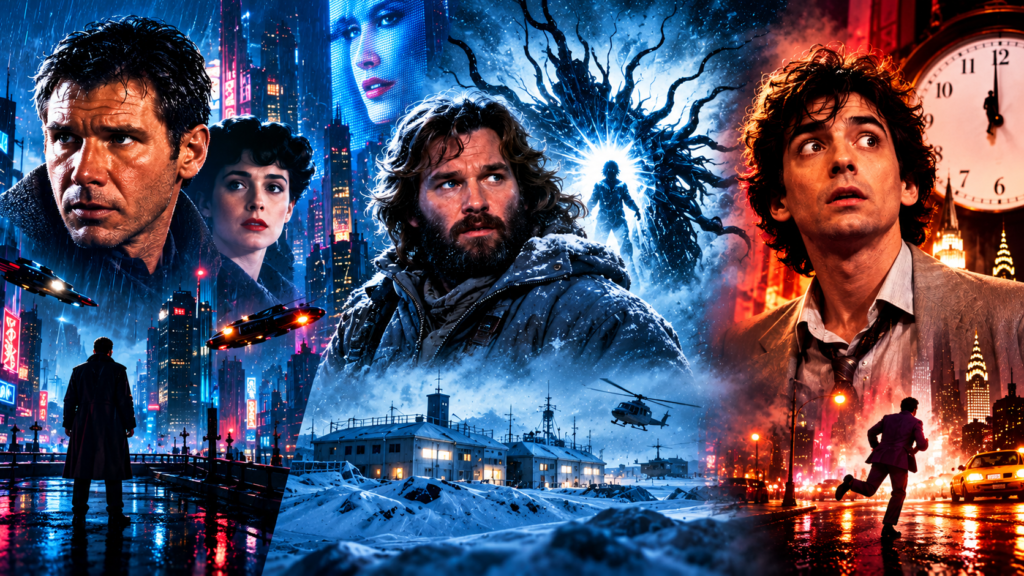
Three cult classics that reveal the darker, stranger, and more experimental side of 1980s Hollywood: Blade Runner, The Thing, and After Hours.
The 1980s gave Hollywood some of its biggest action heroes, iconic blockbuster franchises, unforgettable soundtracks, and revolutionary visual effects. Yet, beneath the decade’s obsession with box-office spectacle lay a collection of films that dared to question humanity, turn ordinary life into a nightmare, and experiment with storytelling in ways that mainstream audiences were not always ready to embrace.
Some of these films initially struggled to find their audience. Others were overshadowed by bigger releases. But time has been kind to them. Today, they remain essential viewing for hardcore cinephiles, regularly rediscovered through digital platforms, film restorations, and conversations about the movies that shaped modern cinema.
For anyone looking beyond the usual Top Gun, Die Hard, and Back to the Future nostalgia, these three underrated Hollywood movies capture a more daring side of the 1980s.
1. Blade Runner (1982): The Future Was Never Supposed to Look This Dark

Director: Ridley Scott
Starring: Harrison Ford, Rutger Hauer, Sean Young, Daryl Hannah
Genre: Science Fiction, Neo-Noir, Mystery
When Ridley Scott released Blade Runner in 1982, audiences were entering an era of optimistic science fiction. Hollywood had witnessed the enormous success of Star Wars, and futuristic cinema often promised adventure, technological wonders, and spectacular battles.
Scott offered something radically different: a decaying Los Angeles of perpetual rain, towering corporate structures, neon advertisements, artificial humans, and a society struggling to distinguish progress from exploitation.
The film follows Rick Deckard, a former police officer tasked with hunting down escaped replicants—artificially created beings who look remarkably human and are fighting for more time to live.
The philosophy: What does it really mean to be human?
At its core, Blade Runner is less interested in flying vehicles and futuristic gadgets than in mortality, memory, empathy, and the ownership of life.
The replicants possess emotions, desires, and fear of death. Meanwhile, the humans who control them often display a disturbing absence of compassion. The film repeatedly asks whether humanity is defined by our biological origins or by our capacity to feel, remember, love, and make moral choices.
Rutger Hauer’s Roy Batty is the emotional centre of this argument. Initially presented as a dangerous adversary, Batty gradually becomes a tragic figure whose desperate struggle for survival challenges the audience’s assumptions about good and evil.
The trend it set: Cyberpunk, future-noir, and dystopian world-building
Blade Runner helped establish a visual vocabulary that countless science-fiction films would revisit: rain-soaked streets, neon-lit skylines, technological decay, omnipresent advertising, and powerful corporations dominating everyday life.
Its mixture of film noir and futuristic science fiction influenced the aesthetic of later works, from The Fifth Element to The Matrix. The film’s production design demonstrated that the future did not have to look clean, shiny, or even particularly desirable. It could be an exaggerated version of the inequalities and anxieties already visible in contemporary society.
The movie’s troubled theatrical reception also became part of its legend. Initially a commercial and critical disappointment, it eventually developed a formidable cult following and earned recognition as one of science fiction’s most influential films. The British Film Institute explores this evolution in its feature, Blade Runner: Anatomy of a Classic.
The stars who made it unforgettable
Harrison Ford was already a major star thanks to Star Wars and Raiders of the Lost Ark. However, Rick Deckard allowed him to explore a more morally ambiguous, emotionally restrained screen persona.
For Rutger Hauer, Roy Batty became one of his most enduring international roles, demonstrating how a supporting antagonist could dominate a film’s philosophical and emotional landscape. Sean Young’s Rachael also became an iconic figure in science-fiction cinema.
Why it still matters: In an age of artificial intelligence, synthetic media, corporate surveillance, and debates over machine consciousness, Blade Runner feels less like a prediction of the future and more like a warning about the present.
Where to watch in India: The film is listed on JustWatch India for streaming through Amazon Prime Video, with rental options also listed. Availability can change.
2. The Thing (1982): When the Real Monster Is Distrust

Director: John Carpenter
Starring: Kurt Russell, Keith David, Wilford Brimley, Donald Moffat
Genre: Science Fiction, Horror, Body Horror
Few films demonstrate the power of a misunderstood masterpiece quite like John Carpenter’s The Thing.
Released in the same summer as more optimistic science-fiction fare, including E.T. the Extra-Terrestrial, Carpenter’s film took audiences to an isolated Antarctic research station where a shape-shifting alien begins assimilating the people around it.
The result is a claustrophobic nightmare in which the characters cannot even be certain that the person standing beside them is still human.
The film received a hostile critical response upon release, with its graphic practical effects and bleak worldview proving divisive. Over time, however, it gained a devoted following and came to be recognised as one of the decade’s most accomplished horror films. The British Film Institute’s entry on The Thing documents this reassessment.
The philosophy: Fear destroys society before the monster does
On the surface, The Thing is a survival horror film. Beneath the gore lies a devastating study of paranoia and the breakdown of collective trust.
The research team initially operates as a community of specialists, bound together by routine and professional responsibility. Once the alien begins imitating its victims, every familiar relationship becomes suspect.
The characters are no longer merely fighting an external enemy. They are fighting uncertainty itself.
Carpenter understands that fear becomes most powerful when there is no reliable way to identify its source. A glance, a conversation, or a seemingly insignificant test can become a matter of life and death.
This philosophy also makes the film unusually unsettling. The characters cannot secure a comfortable victory, and the audience is denied the reassurance of knowing exactly who has survived.
The trend it set: Practical effects as a storytelling weapon
The film’s transformation sequences, designed by the extraordinary effects artist Rob Bottin, remain landmarks in practical makeup and creature effects.
Rather than using its monsters merely as visual attractions, The Thing turns bodily transformation into a source of narrative uncertainty. Every grotesque revelation changes what the audience believes about the characters, the threat, and the possibility of survival.
Its influence continues to be felt across creature features, body horror, survival thrillers, and games built around suspicion and hidden enemies.
The film also demonstrated that horror did not need a reassuring moral conclusion. Its cold setting, restrained characterisation, and refusal to explain everything became essential parts of its identity.
The stars who made it unforgettable
Kurt Russell’s R.J. MacReady is one of his defining genre performances. MacReady is resourceful and tough, but he is never an invincible superhero. He improvises, makes difficult choices, and remains vulnerable to the same uncertainty that threatens everyone else.
Keith David provides a compelling counterpoint as Childs, creating a memorable dynamic of mutual suspicion with Russell.
For Carpenter, the movie stands among his most distinctive directorial achievements. For audiences who first dismissed it as excessive horror, its later reputation demonstrates how dramatically a film’s legacy can change.
Why it still matters: The Thing anticipates contemporary anxieties about invisible threats, contagious uncertainty, misinformation, and the fragility of trust. Its most frightening question remains simple: how can you protect yourself when you cannot tell friend from enemy?
Where to watch in India: JustWatch India lists digital rental options through Amazon Video and Apple TV Store, along with a purchase option. Subscription availability varies.
3. After Hours (1985): A Night When Ordinary Life Becomes Surreal Horror

Director: Martin Scorsese
Starring: Griffin Dunne, Rosanna Arquette, Linda Fiorentino, Teri Garr, Catherine O’Hara
Genre: Dark Comedy, Black Comedy, Surrealist Thriller
Martin Scorsese is widely associated with sprawling crime dramas, volatile antiheroes, and films about power, guilt, and obsession. Yet one of his most revealing works is a small, darkly comic adventure that unfolds over a single night.
After Hours follows Paul Hackett, an office worker who ventures into downtown Manhattan hoping for an encounter with a woman he has just met. What begins as an ordinary evening spirals into a succession of bizarre misunderstandings, threatening strangers, unexpected obstacles, and humiliating situations.
As Paul attempts to return home, the city seems to conspire against him.
It is one of the most unusual films in Scorsese’s career—and a particularly sharp portrait of urban life in the 1980s.
The philosophy: The individual against an absurd world
Unlike the other films on this list, After Hours does not rely on futuristic technology or a supernatural enemy. Its horror emerges from ordinary human interactions.
Paul is constantly trying to explain himself, yet every explanation makes his situation worse. The more urgently he attempts to regain control, the more powerless he becomes.
The film turns embarrassment into suspense and inconvenience into existential panic. Its central character is not a heroic figure confronting a comprehensible adversary; he is an anxious individual caught in a world that refuses to follow reasonable rules.
That is what gives the film its lasting relevance. Anyone who has experienced a disastrous night, an escalating misunderstanding, or the feeling that an entire situation has slipped beyond control can recognise something of Paul in themselves.
The trend it set: Urban alienation and dark independent comedy
After Hours captures a distinctly different vision of 1980s New York from the glamorous, high-energy city frequently seen in mainstream entertainment.
Here, downtown becomes a surreal landscape of bohemian enclaves, strange encounters, desperate characters, and comic menace. Michael Ballhaus’s restless cinematography and Thelma Schoonmaker’s precise editing intensify Paul’s growing panic.
The movie also illustrates how an established filmmaker could experiment outside the scale of conventional studio productions. According to the British Film Institute’s interview with Griffin Dunne, the film helped Scorsese rediscover the urgency and passion that had animated his earlier independent work.
Rather than following the decade’s preference for clearly defined heroes and triumphant resolutions, After Hours embraces uncertainty, irony, and an almost Kafkaesque sense of entrapment.
The stars whose careers the film shaped
Griffin Dunne delivers one of his most distinctive leading performances as Paul Hackett. His increasingly desperate reactions hold together a story that could easily collapse under the weight of its surreal episodes.
Dunne also served as a producer on the film, alongside Amy Robinson and Robert F. Colesberry. His involvement in bringing the project to Scorsese makes the collaboration particularly significant.
Rosanna Arquette, Linda Fiorentino, Teri Garr, and Catherine O’Hara contribute memorable performances that make the film’s strange world feel populated rather than merely eccentric.
The film’s importance extends to Scorsese himself. Following difficulties surrounding his previous projects, After Hours gave him an opportunity to work with a smaller production and a different kind of creative energy.
Why it still matters: Modern life is increasingly defined by overstimulation, social awkwardness, and the fear of losing control in public. After Hours transforms these everyday anxieties into a cinematic fever dream, proving that comedy can be every bit as unsettling as horror.
Where to watch in India: JustWatch India lists After Hours for rental through Amazon Video. Subscription availability may change.
What These Three Movies Tell Us About 1980s Hollywood
These films occupy different corners of the cinematic universe, but together they reveal a side of the 1980s that blockbuster nostalgia can easily overlook.
| Movie | The central idea | Its lasting cinematic contribution |
|---|---|---|
| Blade Runner (1982) | Identity, mortality, and artificial humanity | Cyberpunk aesthetics and philosophical science fiction |
| The Thing (1982) | Paranoia and the collapse of trust | Practical creature effects and psychologically intense horror |
| After Hours (1985) | Alienation and the absurdity of everyday life | Surreal urban comedy and unconventional independent filmmaking |
Their common achievement is not simply that they became cult classics. It is that they trusted audiences to sit with uncomfortable questions rather than providing easy answers.
Blade Runner questions whether technological advancement makes us more human. The Thing explores what happens when trust becomes impossible. After Hours shows how quickly ordinary life can become an irrational nightmare.
Each film also challenges a familiar Hollywood convention. The future is not necessarily better, survival does not guarantee victory, and an ordinary protagonist may never regain control.
That willingness to embrace uncertainty is precisely what makes these films worth revisiting.
The Final Verdict: Which One Should You Watch First?
For philosophical science fiction, start with Blade Runner. For a tense, brilliantly constructed horror experience, choose The Thing. And if you prefer dark humour, unconventional storytelling, and a city that feels like a waking nightmare, After Hours deserves your attention.
The 1980s were undoubtedly the era of larger-than-life heroes and spectacular cinematic universes. But some of the decade’s greatest achievements came from films that were stranger, darker, and more intellectually adventurous than their initial reception suggested.
For the true movie buff, that is where the decade’s most rewarding discoveries begin.
Because Hollywood’s legacy is not defined by box-office numbers alone. Sometimes, it is defined by the films that audiences learn to appreciate long after the credits have rolled.
Stay updated with the latest trends on Fandomora — your go-to destination for breaking movie news, web series updates, anime releases, gaming trends, celebrity insights, and music updates. Explore reviews, OTT release dates, anime guides, gaming walkthroughs, and curated lists to discover the best in global entertainment.
About The Author