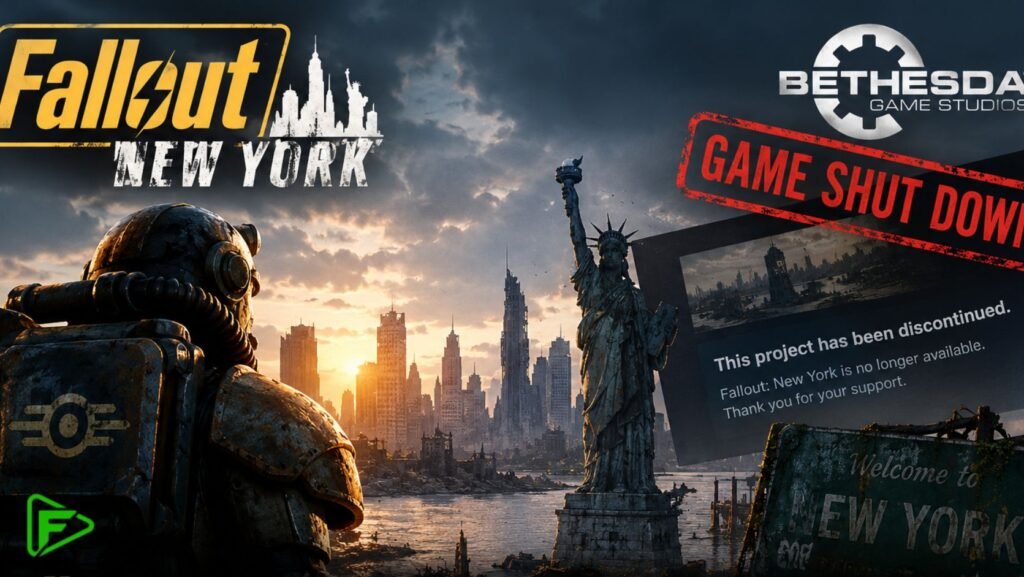
Fallout New York Shut Down: Bethesda Takes Action Against AI-Made Fallout Clone
An AI-generated Fallout game has already run into the one opponent it probably should have expected from the beginning: Bethesda’s parent company, ZeniMax.
A browser game called Fallout: New York, created almost entirely with Anthropic’s Claude Opus 5.5, was released online on September 28. The project attempted to recreate the familiar Fallout formula in a post-apocalyptic version of New York City, complete with quests, dialogue systems, V.A.T.S. and a Pip-Boy-style interface.
It did not stay online for long.
Just days after its release, creator Chris First said he had received a message concerning infringement of ZeniMax’s intellectual property. The project was subsequently shut down, bringing the short-lived AI-made Fallout clone to an abrupt end.
For fans searching for the latest Fallout New York AI game news, the important distinction is that this was never an official Bethesda Fallout project. It was an independently created browser game that used the Fallout name, setting and recognizable gameplay elements without authorization.
What happened to Fallout: New York?
Fallout: New York was presented as an unofficial browser game set in a post-apocalyptic New York City. According to its creator, much of the project was coded using Anthropic’s Claude Opus 5.5.
The idea was straightforward: take the recognizable structure of Bethesda’s modern Fallout games and transplant it into New York.
The game’s promotional material referenced familiar Fallout mechanics, including quests, dialogue trees, V.A.T.S. and a working Pip-Boy. The trailer also showed recognizable New York landmarks such as Times Square and the Flatiron Building reimagined within a post-apocalyptic game environment.
That combination was always likely to attract attention from the owners of the Fallout intellectual property.
Rather than simply being inspired by the broader concept of a nuclear wasteland, the project openly used the Fallout name and leaned heavily on elements associated with the franchise.
Why did Bethesda shut down the AI Fallout game?
The central issue was intellectual property infringement.
Fallout is owned and controlled by Bethesda/ZeniMax, and the franchise contains numerous protected names, characters, designs, fictional concepts and gameplay-related branding.
The creator’s use of the Fallout name alone placed the project directly inside the franchise’s intellectual-property territory. The inclusion of recognizable franchise terminology and features made the connection even more obvious.
According to the source report, First said he received a message from ZeniMax regarding infringement of its intellectual property rights. Following that communication, Fallout: New York was taken offline.
In other words, the game was not shut down because AI-generated games are automatically illegal. The problem was the unauthorized use of Fallout’s intellectual property.
That distinction is important as AI-assisted game development becomes more common.
What was Fallout: New York supposed to be?
The concept behind Fallout: New York was essentially a fan-made interpretation of the Fallout formula.
Instead of exploring the familiar wastelands featured in Bethesda’s games, players would have encountered a post-apocalyptic New York. The promotional footage showed locations inspired by recognizable parts of the city, while the gameplay attempted to reproduce systems associated with the modern Fallout experience.
The pitch included quests, dialogue trees, V.A.T.S. and a Pip-Boy, giving the project an immediately recognizable identity for anyone familiar with the franchise.
The trailer’s visual presentation was noticeably more basic than an official Bethesda production, with low-poly environments and a rough approximation of the series’ visual style.
Still, the ambition was obvious: use AI-assisted development to create a playable Fallout-style experience without going through the traditional development process.
That experiment lasted only a few days.
The biggest problem was the Fallout name
There is an interesting difference between making a game inspired by Fallout and making a game called Fallout: New York.
An independent developer can create an original post-apocalyptic RPG featuring ruined cities, survival mechanics, exploration and branching conversations. Those broad ideas are not automatically exclusive to Bethesda.
But putting Fallout in the title immediately identifies the project with an existing intellectual property.
The same applies to using distinctive franchise terminology and recreating signature systems in a way that strongly associates the project with Bethesda’s series.
That is why the shutdown of Fallout: New York is less a story about Bethesda being opposed to AI and more a story about the limits of using someone else’s established IP.
Was Fallout: New York an official Bethesda game?
No. Fallout: New York was not an official Bethesda game.
It was an independently created browser project. Bethesda and ZeniMax did not announce it as part of the official Fallout franchise.
The timing is particularly interesting because Bethesda already has multiple Fallout projects in development or planned, meaning fans do not have to rely on an unofficial AI-created game to get more Fallout content.
The official roadmap is simply moving much more slowly than many fans would like.
Fallout 5 is still a long way away
For players waiting specifically for Fallout 5, patience remains necessary.
Bethesda has made it clear that The Elder Scrolls 6 remains a major priority before the next numbered Fallout game can enter full production.
That means Fallout 5 remains a long-term project rather than something fans should expect in the immediate future.
The wait has become especially noticeable because Fallout 4 was released in 2015. The television adaptation has also brought a huge new audience to the franchise, making demand for another major single-player game even stronger.
But Bethesda’s development priorities mean the next mainline Fallout game is still some distance away.
Another Fallout project is also in development
While Fallout 5 remains years away, the franchise is not completely sitting still.
Obsidian is also working on another Fallout project following Microsoft’s restructuring of its gaming studios.
The move is particularly interesting for longtime fans because Obsidian developed Fallout: New Vegas, one of the most celebrated entries in the franchise.
Details about the new project remain limited, so it would be premature to treat it as New Vegas 2 or assume a particular location or storyline.
What it does provide, however, is another reason for Fallout fans to keep an eye on the franchise while Bethesda continues working toward its larger projects.
Why Fallout fans are impatient for a new game
The frustration behind projects such as Fallout: New York is easy to understand.
The last major single-player mainline game, Fallout 4, arrived more than a decade ago. Since then, Bethesda has released and supported Fallout 76, while the wider franchise has received renewed attention thanks to the successful television adaptation.
For players who prefer the traditional single-player Fallout experience, the wait has been particularly long.
That gap has created plenty of room for fan projects, mods and experiments attempting to capture the feeling of exploring a radioactive wasteland.
But wanting more Fallout and having the legal right to use the Fallout brand are two very different things.
The AI angle makes the Fallout New York story more interesting
The most unusual part of this story is not simply that an unofficial Fallout game was shut down.
It is that the project was presented as an example of what modern AI-assisted development could accomplish.
The creator described himself as an “AI Creative”, while the game was reportedly coded entirely using Claude Opus 5.5.
That raises a bigger question for the games industry: how much can AI speed up the creation of games, and where does the technology run into the same legal and creative boundaries as traditional development?
AI can potentially help developers produce code, prototypes, dialogue systems, environments and other components faster. But it does not give someone ownership of an existing franchise.
If an AI-assisted project uses protected characters, names, worlds or other recognizable intellectual property without permission, the fact that AI helped create it does not remove the underlying rights issue.
That is the lesson Fallout: New York learned almost immediately.
Can you still play Fallout: New York?
Based on the reported shutdown, Fallout: New York is no longer available as the project was taken offline following the IP infringement complaint.
Because it was an unofficial project rather than a Bethesda release, fans should also be cautious about downloading supposedly restored versions from unknown websites.
The safest route for players who want an authentic Fallout experience is to stick with officially released games and legitimate fan modifications that respect the relevant platform and intellectual-property rules.
What happens next for Fallout fans?
The shutdown of Fallout: New York does not change Bethesda’s official plans.
Fallout 5 remains a long-term project, while another Fallout title associated with Obsidian is also in development.
For now, the biggest takeaway is that Bethesda is still firmly protective of its most valuable gaming franchise. An AI tool can make it easier than ever to prototype a game, but it cannot give an independent creator permission to turn another company’s intellectual property into a new commercial or public-facing project.
And that is exactly where Fallout: New York crossed the line.
The experiment may have lasted only a few days, but it offers a surprisingly useful glimpse into the future of AI-assisted game development: the technology can make creation easier, but it does not erase ownership, trademarks or copyright.
Fallout New York vs the official Fallout games
Fallout: New York was an unofficial browser project created with extensive AI assistance. Bethesda’s Fallout games, meanwhile, are official releases developed within the franchise’s established ownership structure.
That difference matters more than the technical method used to make the game.
The unofficial project could experiment with a New York setting and recreate recognizable Fallout mechanics, but it could not legitimately present itself as a new Bethesda entry.
For fans, the distinction is simple: AI can help create a game, but it cannot turn an unauthorized project into an official Fallout sequel.
Frequently Asked Questions
1. Why was Fallout: New York shut down?
Fallout: New York was taken offline after its creator said ZeniMax contacted him regarding infringement of the company’s intellectual property rights. The project used the Fallout name and recognizable franchise elements without being an official Bethesda release.
2. Was Fallout: New York made using AI?
Yes. According to the source report, creator Chris First said the browser game was coded entirely using Anthropic’s Claude Opus 5.5.
3. Was Fallout: New York an official Bethesda game?
No. It was an unofficial browser game and was not announced or released by Bethesda.
4. Is Fallout 5 still happening?
Yes, but it remains a long-term project. Bethesda’s current priorities mean Fallout 5 is expected to enter full production only after The Elder Scrolls 6.
5. Is another Fallout game being developed?
Yes. Obsidian is working on another Fallout project, although detailed information about the game remains limited.
6. Can AI legally make a Fallout game?
AI can be used as a development tool, but using AI does not provide permission to use Bethesda’s Fallout intellectual property. An unofficial project using protected franchise elements can still face intellectual-property claims.
7. Can I still play Fallout: New York?
The reported project was shut down after the IP complaint. Because unofficial copies may circulate online, players should be careful about downloading files from unverified sources.
8. Why are Fallout fans waiting so long for Fallout 5?
Bethesda has prioritized The Elder Scrolls 6, meaning the next mainline Fallout game remains a long-term project rather than an imminent release.
Stay updated with the latest trends on Fandomora — your go-to destination for breaking movie news, web series updates, anime releases, gaming trends, celebrity insights, and music updates. Explore reviews, OTT release dates, anime guides, gaming walkthroughs, and curated lists to discover the best in global entertainment.
About The Author